Monday, August 31, 2009

Meanwhile in Lewa Wildlife Conservancy/Kenya...


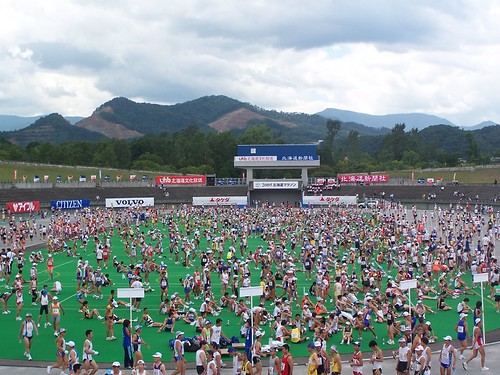
mzungo.org reader and winner of last week's goodie Erwan Piriou is sticking it out at the "damn hot" edition of the LEWA marathon. The picture is taken during the first of two loops. He blames heat and having only run ten 40 mpw weeks for his 3:18h with a positive split. He'll be back in 2010 to prove his claims.
The polo shirt will be on its way shortly!

Liza Hunter-Galvan EPO+: a blogger's opinion

mzungo.org says: We try to be a positive place (and not positive in a drug test result meaning of things). It's mainly because we hate and disrespect dopers dearly and deeply. As such, we have tried to avoid talking too much about doping or at least put it in a positive context (think Asbel Kiprop takes gold off Haschisch Ramzi). However, the follwing article about EPO cheat Liza Hunter-Galvan is - as self described - "harsh, harsh...but fair..." and so we decided to post it. It's not for the faint of heart but let's face it, sticking a needle into your arm, between your toes or whereever people put that stuff, isn't either.
P.S. If you call us ambiguous for our today's Dieter Baumann header: that's a whole another issue we are certainly happy to discuss.

Here we go:

"It was always improbable that a short, squat, vaguely athletic chick named Liza Hunter-Galvan could go from being a shit marathoner runner to one of fairly decent accord at the age of 40 - and what do you know, it turns out it really was impossible.

Well, without EPO of course...

The stitch-up team was partial to this knowledge a couple of months ago, but in the vague interests of respectable sports journalism (and complete lack of knowledge regarding what legally could or couldn't be written) decided not to touch it with a 40 foot pole.

But as of today everybody knows about it, so why hold back? Don't mind if I do then good sir...

New Zealand marathon runner Liza Hunter-Galvan has been suspended for two years for an anti-doping violation.Hunter-Galvan underwent an out-of-competition drug test on March 23 with a laboratory report in May confirming her sample had tested positive for EPO. Hunter-Galvan requested that her B sample be analysed and a lab report on June 29 confirmed that sample had also returned a positive test.
She has since admitted to the Tribunal that she took the EPO.

Okay okay, so she didn't really take EPO - she took Recormon which she "heard" was a "vitamin" supplement. I guess that's believable given Recormon sounds totally like some sort of naturally derived vitamin product and all...
However after few trips to the chemist, probably a couple of hundred bucks later, a google search and a few "headaches" - it dawned on Liza that what she was doing was probably a little sinful.

Still, it was the first and only time she ever cheated - it always is right? Which of course is a little hard to really believe coming from someone who, let's cut the fucking shit here, knew exactly what they were doing all along. Kind of like the serial killer who swears the other ten bodies buried in his back yard have nothing to do with him despite the twenty severed heads packed in his deep freeze.

It's also hard to swallow given that one look at Liza and you could be forgiven for thinking she worked as a telemarketer for Electrolux vacuum cleaners, rather than being a fairly world class female marathon runner. EPO only three times? - shhhuuuurrrreeee...

The stitch-up team never liked LHG. We thought she was obnoxious, unprofessional and not very good. Major Championships were more like a fucking holiday to her than a very privileged opportunity to represent her country - a privilege very few are ever awarded. She wasn't really a true New Zealander either. After living in Tex-arse for all those years she seemed to have inherited that innate arrogance, self-inflated egotistical bullshit and social awkwardness that so many Americans seem to come intrinsically packaged with. We thought she was a bit of a cunt to be honest.

Well, the jury is back and she's not just a cunt but a cheating cunt - arguably the worst variety of cunt. Right up there with Marion Jones and Kelli White. A super cunt...

It's all the more hard to fathom given the fucking legal rigmarole this snotty little bitch put quite a few people through just to get to the last Olympics. Based on pure performance there is no way she should have been given that chance in the first place. Lucky for her someone didn't quite get the wording right in the selection policy so she collected another tracksuit and got a fully-paid holiday. Sure, this has nothing to do with drugs as at this point because we never knew - but every story needs a good dose of irony and this is about as good as it gets.

Speaking of irony - how about some macabre irony? We all had our heart strings tugged by the genuinely sad tale of her daughter who suffered serious brain trauma in an automobile accident, and how Liza was "fuelled" by this tragedy to pursue her athletic dreams. Turns out she wasn't literally fuelled by this, but by a syringe packed with Recorbin - way to shit all over that memory Liza AND all the people that took your side here in New Zealand during that whole debacle. Dude, seriously.

And way to shit all over a legacy of great New Zealand Olympic runners. As far as I know, up until today, no New Zealand Olympian that has competed in a running event has ever been caught for using performance enhancing drugs. A legacy that includes Jack Lovelock, Murray Halberg, Peter Snell, Nicholas Willis, John Walker and Lorraine Moller. A legacy that also includes many others who never quite scaled the heights those great names have done - but nevertheless put their heart and soul into representing their country, trying to beat the odds, and doing it the right way. I mean for fucks sake - you could at least have been somewhat good.

There is no politically correct way to get around describing this so this is how it rolls here at the stitch-up. Harsh? Yes - but as our 3rd (or 4th?) office aphorism goes - "It's harsh, harsh...but fair..."

Liza Hunter Galvan is not the first, last or only cheat in the world of track and field. Even though now in 99.9% of cases I am personally over caring about who or who doesn't do what in terms of drug taking these days - I do care about this. It's rude. It's shit. When it comes to our silver fern emblazoned vest getting dragged through the poop by some rude little bitch who can hardly lay claim to calling this country home anymore - it really, really pisses me off.

And if you don't agree with me - I couldn't give two fucks. Sue me."

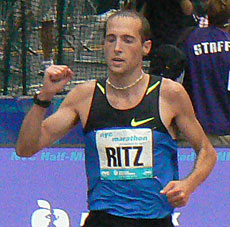
Ritz mania continues: Burfoot says "Do it on 40 mpw"

RW's Amby Burfoot has a thought provoking idea for Ritz: limit your run training to 40 miles per week. Maybe this will allow him to break mzungo Dieter Baumann's 12:54? Until then, mzungo.org is not that impressed.

Dear Dathan: Congratulations on your impressive 12:56.27, the new American record for 5000 meters. You remind us once again that, since the fall of 1999, you've been the one. I hope you'll have many more record-breaking races. But first, a few words of caution: Now it gets tougher.

Dear Alberto: Congratulations on whatever you did to help Dathan set this new record. Especially giving him that long, hard drive to the finish. I can't figure how you taught Galen and Amy and Dathan to produce such great kicks, but please share it. There are lots of us out here who could use help in the fast-finish department. I hope you'll guide Dathan to many more great races.

But first a few words of caution: Now it gets tougher.

I'm referring to several things. First, the obvious one: It's not easy to improve on personal bests and American records. The higher you climb, the more difficult it is to reach the next rung. Dathan isn't in a class by himself; he's not a Kenny B; he can't afford mistakes or to take a willy-nilly approach to cross-country, track and the roads. To achieve his potential in the coming years, Dathan will need a smart, tightly focused plan.

A big part of this plan will have to be injury-prevention. I hate to label Dathan, the once indestructible Michigan high schooler, as an injury-prone runner. Let's just say that in recent years he hasn't always produced his best performances at the most important times. And if there's one thing we know about injuries, it's that past injuries are predictive of future injuries.

Happily, Dathan gets racing fit very quickly. He's almost East African in that regard. That's a rare talent among Americans, and one that has to be nurtured.

So here's my proposal: Be courageous, and make Dathan a guinea pig in the Great Training Experiment. Put him on a 40-mile-a-week training program.

Sure, I know most of the great ones run 100+ miles a week. But there's little to no evidence saying 100 is better than 40. It's just what the elites do because they're obsessive types (often a good thing, by the way, but not always), as are their coaches. Few elites have the nerve to break from the customary practice, especially not when they hear or read about their rivals' impressive training.

But let's remember that a handful of great runners have followed a different path. What did Roger Bannister run, 12 to 15 miles a week much of the time? And Henry Marsh was always said to be a low-mileage trainer, which didn't stop him from making four U.S. Olympic teams and holding the American record in the steeplechase for 27 years. Not too shabby. Like many others, I'm a big fan of Coach Jack Daniels, Ph.D., who's basic philosophy is: Get the best results you can get with the least training.

This doesn't mean that more isn't better. Often it is, and Brian Sell is probably a good example of that. But more isn't always better. There are individuals, perhaps more than we realize, who would be better served by less training than by more. And Dathan Ritzenhein is beginning to look like one of these.

Let's consider what you could do in a 40-mile training week. How about a 16 over the weekend, with the last 6 miles at 5:00 to 5:20 pace? And a nice interval workout a few days later, say 4 x 800 in 2:00, followed by 4 x 200 in 28. Nothing outrageous (for Dathan), just solid work. And then a couple of days later, a smooth, progressive 8-mile tempo run that might include 2 miles at 5:40, 2 at 5:20, 2 at 5:00, and 2 at 4:40. That gives us a total of 16 miles for the long run, 10 for the interval day (with lots of warm up and cool down), and 12 for the tempo run (with warm up and cool down). My math says this adds up to 38 miles. It also says this runner could run fast from 5000 meters on up.

Of course, Dathan should do a lot of other stuff. All that Nike can afford, in fact. He should sleep 10 hours a day in a altitude chamber, do tons of cross-training on non-impact machines, work out occasionally on low-gravity and under-water treadmills, and find the best physical therapist-trainer out there to be his personal strength/flexibility coach.

The only thing he shouldn't do is run more than 40 miles a week, or whatever low ceiling he and Alberto agree on.

Because the goal isn't to train harder than anyone else or to log more miles. The goal is to find the training program that works best for you, and then to race as fast as possible.

Sunday, August 30, 2009

Njenga and Shimahara Top Hokkaido

Two veterans made comebacks to win the 2009 Hokkaido Marathon in its first edition on a new course. In the men's race Kenyan Daniel Njenga (Team Yakult) endured a relatively slow first 5k of 15:46, typical of hot, summery Hokkaido, before cutting loose at 12 km with a surge at world record pace. From 12 km to 18 km Njenga ran under 3:00 / km pace, clocking as fast as 2:50 / km to kill off all rivals. He hit halfway in 1:04:11 with a chase pack of three including fellow Kenyan Laban Kagika (Team JFE Steel), Seiji Kobayashi (Team Mitsubishi Juko Nagasaki) and debutant Takayuki Tagami (Team Kyudenko) around 25 seconds behind.

A minute ahead of the Hokkaido Marathon record, Njenga began to slip in the heat and was down to 3:10 / km pace by 25 km. He continued to fade, but the chasers were likewise suffering and could make no headway. Approaching 40 km, first-timer Ryo Yamamoto (Team Sagawa Express) cruised past into second as Njenga dropped to 3:20 / km. Yamamoto almost closed the gap but fell 8 seconds short as Njenga crossed the line in 2:12:02, the second-fastest time ever in Hokkaido. Yamamoto was 2nd in 2:12:10, with Kagika a short way back in 3rd in 2:12:24. Defending champion Masaru Takamizawa (Saku Chosei H.S.) was 4th in a credible 2:13:05, while Kobayashi slipped to 5th. In his post-race interview Njenga said that he had been suffering leg pain earlier in the month and had been unsure whether to run Hokkaido, but was very happy to win. It was his first good marathon since his last win in the 2007 Tokyo Marathon and brought his lifetime marathon victory count to three.

2008 Honolulu Marathon champion and noted hot weather specialist Kiyoko Shimahara (Second Wind AC) took the race out fast from the gun accompanied by her teammate Akemi Ozaki (Second Wind AC), the older sister of World Championships marathon silver medalist Yoshimi Ozaki (Team Daiichi Seimei). Challenges from 2009 Tokyo Marathon winner Mizuho Nasukawa (Team Aruze) and Olympian Naoko Sakamoto (Team Tenmaya) never materialized, and after a summer training in Albuquerque, NM with World Championships marathon 7th placer Yuri Kano (Second Wind AC) both Shimahara and Ozaki were fit enough to make it a two-woman race. The pair were over 15 seconds ahead of Masako Chiba's Hokkaido Marathon record pace at 10 km before Ozaki lost contact, but at halfway Shimahara was still on track with a 1:11:02, her best half marathon time in three years and less than a minute off her half PB.

At 25 km she was still going strong and was 42 seconds up on the record, but at 28 km Shimahara abruptly began having some kind of trouble, clutching at the left side of her chest and tugging at the neck of singlet before her coach Manabu Kawagoe ran up on the parallel sidewalk and shouted advice to her. The crisis passed, and although her pace had dropped it was clear that barring a major disaster Shimahara would not only break 2:30 for the first time since 2006 but also crack her PB of 2:26:14 from Hokkaido '05 and possibly hold out for Chiba's record of 2:25:46. Her aggressive sub-3:25 / km splits never returned, but Shimahara held on for the win in 2:25:10, achieving not only the record and a new PB but also setting the second-fastest time of the year by a Japanese woman and tenth-fastest worldwide, faster than Yoshimi Ozaki and Yuri Kano's times in the Berlin World Championships despite the heat. Like Njenga it was her third marathon win.

Akemi Ozaki held on for 2nd in 2:27:23, likewise a PB by over a minute. Combined with Kano's run in Berlin, Shimahara and Ozaki's Hokkaido performances complete a big week which marks Second Wind and coach Kawagoe the dominant force in Japanese women's marathoning at the moment, a noteworthy achievement in that they are an independent group which broke away from Team Shiseido in 2007 to exist outside the jitsugyodan corporate team system. Shimahara's win shows that she is still competitive and gives her the confidence to try for the overseas major win which, apart from Honolulu last year, has thus far eluded her.

2009 Hokkaido Marathon - Top Finishers
will be updated with complete results shortly
Men
1. Daniel Njenga (Team Yakult) - 2:12:02
2. Ryo Yamamoto (Team Sagawa Express) - 2:12:10 - debut
3. Laban Kagika (Team JFE Steel) - 2:12:24
4. Masaru Takamizawa (Saku Chosei H.S.) - 2:13:05
5. Seiji Kobayashi (Team Mitsubishi Juko Nagasaki)

Women
1. Kiyoko Shimahara (Second Wind AC) - 2:25:10 - PB, MR
2. Akemi Ozaki (Second Wind AC) - 2:27:23 - PB

Blog Roll: Jason Pyles

105miles on 11runs in 7days:
Week 11 Base +Specific


M: 9miles/ 7miles
T: 12miles with 8x800 CI/ 5miles
St.Albans Track for CI's(50-55sec recovery)
W: 18miles at Kanawha State Forest(Hilly+steady pace)
T: 8miles/ 7miles
F: 12miles w/4mile Tempo(20:38/5:09avg) / 5miles
Splits: 5:14, 5:10, 5:08, 5:05 @Laidley Track
S: 6miles(very early and calf got tight so missed pm run)
S: 16miles relaxed and easy (w/ big group first 11miles)
(Marian ran solid this morning running 7:10s for her LR. She is slowly getting there!!)


Recap: Solid week, had planned around 115 miles but missed Saturday night due to being very tired from early morning travel to Morgantown for the XC meet. Plus the calf got really tight on the early Saturday run from not being use to getting up and right out the door at 4:30am. Little scare that I seem to have covered with proper rehab. Still need to be careful and play on the side of caution if I feel it next week. Finally brought in true workouts this week and they both went well, actually Tuesday's workout probably jumped started my get serious about not just miles but now specific work. Friday tempo was just a cruise on the track, one of those day's that had I felt really smooth and relaxed and got back to the cut down style Tempo work where the last mile feels just as easy as the first. I felt it was a good sign that I'm fairly fit off the summer of base and if that doesn't reflect in my race next weekend then I know it will come late fall marathon time!

UCXC: Trained them hard this week and went to WVU for a hard workout but wanted to see how they reacted in a race(even if low key). I think were going in the right direction overall, we just need to get a little more committed to racing people. Didn't see any "fight" in their eyes with 600 to go and people a head of them. They can get there, they just need to get that "want to get there" attitude right now.

Strands: JOIN: http://runpyles.blogspot.com/ and follow me "runpyles". Detailed daily training comments plus much more!!

MZUNGO CLASSIC: Orlando Pizzolato wins the New York City Marathon in 1984


Wikipedia says: Orlando Pizzolato (born July 30, 1958) is a retired long-distance runner from Italy, who represented his native country in the men's marathon at the 1988 Summer Olympics, finishing in 16th place (2:15:20). His biggest success was twice winning the New York City Marathon (1984 and 1985), and the silver medal in the men's marathon at the 1986 European Championships in Stuttgart, West Germany.

Video: 2009 Weltklasse Zurich - Kenenisa wins, Ritz sets AR at Zurich

Kenenisa wins 5th Golden League in 5000M- Amazing Finish http://www.diretube.com - Ethiopian Video Sharing Site.

American Dathan Ritzenhein set the American Record in 12:56

Ritz's Splits
30.9 [15th], 61.8 [1:32.7] [15th],
61.8 [2:34.5] [15th], 61.3 [3:35.8] [15th],
62.7 [4:38.5] [15th], 62.2 [5:40.7] [14th],
62.8 [6:43.5] [12th], 63.9 [7:47.4] [11th],
62.9 [8:50.3] [9th], 62.9 [9:53.2] [8th],
62.5 [10:55.7] [7th], 60.4 [11:56.1] [3rd],
60.2 [3rd]
2:00.6 for his last 800, 4:06 last 1600.


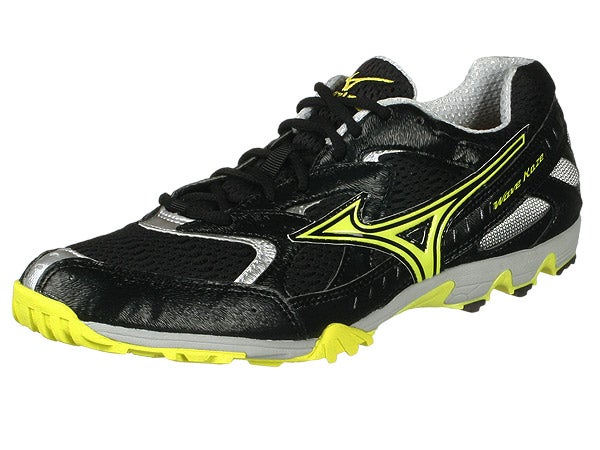
Get your kicks: Mizuno Kaze 2 Dimple

Blog Roll: Falk Cierpinski

THE FOLLOWING ARTICLE IS TRANSLATED FROM GERMAN USING GOOGLE TRANSLATOR!

The story is quickly told. I was in top form at the start, I could never prior speedwork or run 40km in such qualities, such as in Saint Moritz.

The only problem occurred with the Vattenfall City night 3 weeks ago. At km 8, I got extreme side stitches and even had to stop during the race. The same problems I had this year as early as the spring in Lisbon, in Dusseldorf from the first half and in the last 3 weeks even in training. I have been to several times the osteopath and they told me that this was a problem with the liver and bile. These organs to swell and push or pull on the tapes, which are also dependent on the diaphragm. What it means for breathing, when the diaphragm can not work properly, is certainly clear. I sent the whole deal several times as bad as yesterday, it never has been.

At km 5, this time it went off and I was able to get a little breathing exercises against it. I tried to relax and relieve a bit of everything but the problems were schliimmer rather than better. I could only embark on a medium-tempo, at least to be able to breathe somewhat. Once the breathing was a little higher, gripped together my whole right side. For any other race I'd probably got out long ago, because under these circumstances, simply not a normal walking is possible. But I was the third runner for Germany, which is just for the World Cup and his colleagues can not be hanged.

I'll do a short, 37km long, it was hell with such liver stitches to run and look like 1 years work and 14 weeks training camp just like that slip through our hands. About 10 times I had to stop in between because the painful cramps were too strong and only the team and the spectators at the track let me continue. There are truly beautiful moments than with my last name on the chest at the end of the field (approx. 9min slower than my fastest trotting) and not quicker.

Spectators were particularly impressive for me. Although I was off so far, was the support just unbelievable. In the last two kilometers, Unter den Linden, I then looked again at the faces aware at the track and saw the enthusiasm of the people. Only then I realized that it was worth it to continue to run to. I have tried to absorb at least the last moments of the line and maybe I can take with them a little bit into the next Winertrainng. I'm sorry that I could not show it sometimes plays the body just does not cooperate. In the next few days, I'll definitely have to visit the doctor time to move this matter to the bottom of time.

At the moment I'm just depressed erstmal, a chance at home, it will certainly never be like ... But somehow I'm also a little proud. Thanks for the support at the track on their TVs, to my sponsors, to Verena, my father and my mother, Andre and Martin, who had to take 14 weeks for the work in the office that my father was lying, when he was with me in training camp.

I will try to get up again soon ...

Blog Roll: Sally Meyerhoff: Just when I thought I was really strong…


So I have been doing a great core and total body strength training routine consistently for about a year and a half. I usually do it every other day and before races taper off of it a few days out. The routine mostly consists of Pilates type strengthening, lunges, calf raises and lots of stuff with my exercise ball. I know it keeps me structurally strong and I notice a difference if I haven’t done it in a week or two and I start again; I feel sore in certain areas.

After some research and watching some videos on strength training that my massage therapist gave me, I had come up with a whopping 60 additional exercises I wanted to add in!!! I realized trying to do all of them in one day would probably take me about 4 hours. No thank you! I divided them up and now I’ll do about 10 per day, making my regular full strength training days a tad bit longer. Today was one of those days…

I bought a few at-home pieces of equipment to add to what I already use. I loved going to LA Fitness back in Arizona yet we don’t have one here in Eugene so I do my stuff at home. It’s great though..I get to choose my own music and don’t have to worry about someone using my equipment for 30 minutes when I need it! ha One thing I bought is a pull-up bar. Now, typically I am not a big pull-up person…yet when challenged to see how many I can do, I can at least manage 2-3 before collapsing. Today I did 4.5 and I was so happy!! My goal in the next month is to get up to 10! We’ll see if I can do it.

After my strength training session today lasted about an hour and a half I was spent. I laid on the floor and it actually felt fantastic to be breathing hard and feeling like my arms and legs were made of jell-o. I really considered myself to be a strong female athlete yet today showed me there is always something harder to try and do! Two runs and two other workouts today truly make me feel like a professional athlete! It’s 6:15 pm and I think I could go to bed now I’m absolutely loving this. The feeling of being ridiculously exhausted and doing new things I’ve never done before is exactly what I want right now. 5 weeks from right now I will be arriving at my hotel in St. Paul and all this work will be so worth it

Kenyans show form in Zurich


Africa 800m champion David Rudisha and Commonwealth games 5,000m winner Augustine Choge rebounded from their poor showing at World Championship a week ago to win at the Zurich Golden league meeting in Switzerland on Friday night.

Also salvouring his moment of glory was World 3,000m steeplechase champion Ezekiel Kemboi who won in his specialitin a time of 8:04.4.

However, it was Russian Yelena Isinbayeva, who improved her World Pole Vault record (5.05m set in Beijing Olympics) with a first time clearance at 5.06m.

Isinbayeva’s world record victory kept her in the hunt for the Sh76 million ($1 million) jackpot which will be decided on Friday in Brussels. The Russian made sure she would be in the running for the big prize in Belgium with her first time clearance at 4.81.

She was also clear on her first attempt at her opening height of 4.71 which comfortably beat the best attempt by world champion Anna Rogowska of Poland - 4.76 on the second attempt. Brazil’s Fabiana Murer was third, 4.71m.

In the 100m world champion and record holder Usain Bolt left it late before taking over the initiative after roughly 80 metres. He did not disappoint and came away clear to record a 9.81 second success.

Powell despite tying up a little in the final metres still produced 9.88 for second place, and two others went below 10sec – Darvis Patton (9.95) and Michael Rodgers (9.98). The Jamaican admitted his early race display was lacklustre by his standards.

“It was alright, I would say this was a shaky race. My body was sitting at the start, I was a little bit tired through the race. But again, it’s alright. All things considered, the time is not bad. I need to pick up my speed as my body did not respond well to the race.”
World leads

As well as Isinbayeva’s pinnacle performance, there were four other 2009 world leads, nine Berlin champions won while another five fell at their first post championship hurdle. In the Golden League Jackpot stakes, three of the four aspirants made it through to the sixth and final challenge in Brussels next Friday.

In the men’s 800m, European champion Bram Som lead the field behind the last pacemaker into the second lap with David Rudisha, Yuriy Borzakovskiy, and World champion Mbulaeni Mulaudzi in close order behind the Dutchman.

The same group prevailed as the race entered the last 100m and it was then that Rudisha applied top gear which took him home in a personal best time of 1:43.52.

Coming home with a characteristic late attack was Alfred Yego, the 2007 World champion who had taken silver in Berlin, who powered past all but the eventual winner finishing second in his career best of 1:43.66, with Mulaudzi the man who beat him in Berlin, third in 1:44.03; Som hung on for fourth (1:44.10).

Kemboi, Choge and Rudisha in golden wins


Fresh from his World Championships victory in Berlin last week, Ezekiel Kemboi Yano won the men’s 3,000 steeplechase in 8:04.44 at the Weltklasse Golden League meeting in Zurich on Friday.

Olympic champion and compatriot Brimin Kipruto finished back in eighth place (8:20.24), while Abel Mutai was seventh in 8:18.70.

Michael Kipyego tripped and fell flat on the track midstream, but clawed his way back to finish fourth, timing 8:09.54.

Paul Kipsiele Koech, who finished fourth in Berlin Worlds, was third (8:06.10) behind Frenchman Bouabdellah Tahri, who timed 8:05.29.

Richard Mateelong, who was second in Berlin, finished fifth (8:10.25).

In other races which Kenyans dominated, david Rudisha won the 800m race (1:43.52) ahead of Alfred Kirwa Yego (1:43.66) and South Africa’s Mbulaeni Mulaudzi (1:44.03).

Unbeatable Choge

Augustine Choge was unbeatable in 1,500m, which he won in 3:33.38 as Belal Mansoor Ali (John Yego) of Bahrain followed in 3:33.74 and Asbel Kiprop third in 3:34.09.

World 800m champion Yusuf Saad Kamel, formerly Gregory Konchellah, of Bahrain, was fourth in 3:34.33.

Olympics 1,500m champion, nancy Jebet Lagat, faded to seventh and compatriot Viola Kibiwott one step behind in the women’s 1,500m, which was won by Bahrain’s Ethiopian-born, Maryam Yusuf Jamal.

Ethiopia’s Kenenisa Bekele continued with his hunt for the 5,000m Jackpot where he won the race in 12:52.32, beating Kenyans Edwin Soi to second (12:55.03), Vincent Chepkok to fourth (12:58.17), Joseph Ebuya to seventh (13:00.22), world bronze medallist, Moses Masai to eighth (13:06.16) and Silas Kipruto to ninth (13:09.08).

The Zurich Meeting attracted a typical world-class cast, most of whom were in World Championships.

What´s next Matt Gabrielson?


Three more years.

That’s how much time former Drake University runner Matt Gabrielson figures he’s got left in his competitive running legs before he possibly calls it a career as a professional.

“I think I’ll do one or two marathons a year for the next two or three years and give the Olympic team a run,” Gabrielson told me. “And then run off into the sunset after that.”

Gabrielson had a very successful run in the World Track and Field Championships, placing 36th overall in the men’s marathon a week ago. He was the second-highest finisher.

He plans to run either the Twin Cities, New York or Chicago Marathon next fall, but first he says he has a few other goals to accomplish first.

“I want to break 4 minutes in the mile in indoor track,” Gabrielson said, and then focus on the 10,000 meters and get it in 28:10 or under. I still have some 10,000 meter demons to settle.”

He figures the first half of 2010 will be spent honing his speed on the track and reaching those mile and 10k goals. Then he will venture pretty much full-time into marathons, with the target trying to make the 2012 Olympic team in that event.

“I like the marathon, like the challenge of it,” Gabrielson said. “I want to kind of be good at lot of distances. I’m preparing for that one day (when it will be over), unless I figure something out with the marathon.”

Gabrielson, 31, was a charter member of Team USA Minnesota way back in 2001. He hardly can believe it’s been almost a decade since he arrived in the Twin Cities with the goal of becoming a professional runner. He’s made lifelong friends with other members of the team and been a part of four U.S. teams in world championship events.

“It’s been a good long ride,” Gabrielson said.

And it’s not over. Yet.

GOOD NEWS: I got the news I was hoping to hear Friday. My surgeon’s office called with the news that I needed to schedule my nasal surgery.

So Monday, Sept. 14 is the day I will hopefully gain some relief from sinus buildup and pressure. I will miss two weeks of running after that to recover, which means I will have to skip one of my favorite races, the Capital Pursuit. But I will be back running in October and plan to run on a relay with my four members of our new race team in the Des Moines Marathon.

VIDEO: Ritz's post-race


Dathan Ritzenhein's 6th-place finish in the World Championships 10K earlier this month signaled the Olympic marathoner still has a lot to give on the track... but an American Record at 5K?! Tonight in Zürich, the Colorado alum knocked off Bob Kennedy's standard with a 12:56.27 clocking that found even Ritz himself a little surprised. Click player above for video of Ritz's post-race reaction.

CLICK ON THE PICTURE TO WATCH THE VIDEO

Hunter-Galvan accepts two-year doping ban


San Antonio-based Olympic marathon runner Liza Hunter-Galvan admitted Friday to using performance-enhancing drugs and said that she accepts a two-year ban from competition.

“There’s not a lot more to say,” Hunter-Galvan said. “It’s an awful mistake and I deeply regret it.”

An attorney working with the 40-year-old mother of four described the sanction as “a two-year ban from all competition, starting on May, 29, 2009.”

Hunter-Galvan, a New Zealand native, said in a statement that she had been clean for her “entire career” until she took the banned substance three times earlier this year, once in February and twice in March.

A statement from Athletics New Zealand said the ban was ordered because Hunter-Galvan tested positive for erythropoietin (EPO), a prohibited performance-enhancing substance. The out-of-competition test was conducted on March 23.

As a result of the ban, she said it was her understanding that she won’t be able to run this year or next year in the San Antonio Rock ‘n’ Roll Marathon and Half Marathon.

“I can’t run, period,” said Hunter-Galvan, who finished second at the inaugural Rock ‘n’ Roll event last year. “At least, that’s my understanding.”

The ban likely ends any hopes that Hunter-Galvan may have had to compete in the 2012 Olympic Games in London.

A San Antonio resident since 1988 when she enrolled in school at UTSA, she ran the marathon for New Zealand in the 2004 and 2008 Olympic Games, finishing 51st and 35th.

Hunter-Galvan said she was almost certain even before the ban that she wouldn’t make another try for the Olympics.

“That was doubtful,” she said. “I’m not getting any younger. I had enough fighting and dealing with trying to make the (New Zealand) team (in the past). It takes its toll.”

In both 2004 and 2008, Hunter-Galvan prevailed in appeals with New Zealand officials to win a spot on the Olympic team.

Scott Newman, chief executive officer of Athletics New Zealand, criticized Hunter-Galvan sharply.

“It is abhorrent to think that a New Zealand athlete would choose this path,” Newman said in a statement, “but it would be naïve to think that some of our athletes are not at times exposed to the temptation of performance-enhancing substances.”

Newman said the ban is a message “that cheats are highly likely to be caught.”

In a telephone interview Friday morning, Hunter-Galvan apologized.

“I’m sorry if I disappointed people,” she said. “I’ve made a terrible mistake.”

Pointedly asked why she took the drugs, Hunter-Galvan said, “I don’t have a good answer. I was in a bad state of mind at the time and I made a really bad choice.”

She said in a release that officials in Athletics New Zealand had been critical of her performance at Beijing. The exchanges that extended into early 2009 left her “experiencing symptoms of mental anguish.”

Hunter-Galvan identified the drug she took as Recormon.

According to Web sites carrying medical and pharmaceutical information, Recormon contains the active ingredient recombinant human erythropoietin, which stimulates the production of red blood cells.

She said she took it three times, on Feb. 26, March 13 and March 20. She was tested three days later at her home.

The news of Hunter-Galvan’s ban saddened former Olympic swimmer Josh Davis, who had become friends with Hunter-Galvan in the past few years while working with the runner at various civic functions.

“You just have to stay humble, put your head down and keep pressing forward,” Davis said. “Trust that your character and all you’ve done up until that time still counts for something, and what she does from here on out also counts for something. And like I said from the very beginning, she’s my friend, no matter what.”

Running apparel store owner Roger Soler said he was disappointed in Hunter-Galvan’s actions, but added that he also supports her as a friend.

“It’s a little disappointing, but at the same time, friends will show support through all times when things get rough,” he said. “So it’s time for everyone to stick around and still be friends. You can be disappointed and sad at the conduct, not at the person.”

Soler said that while he strongly disapproves of drug use by athletes, he hopes that Hunter-Galvan’s actions will not be judged too harshly.

“I’d like to see somebody raise their hand that they are perfect,” he said. “I don’t see anybody raising their hand right now.”

Last week's mzungo.org goodie winner is rocking his NYC shirt in Bavaria


Saturday, August 29, 2009

Get your kicks: ASICS Spring 2010 - Piranha SP3

get your kicks: adidas adizero Aegis (Wh/Bk/Rd)

World championships: Kara Goucher 10th in women's marathon

For about 90 minutes on Sunday, Kara Goucher felt relaxed, strong and confident that she could win the women's marathon at the IAAF World Championships.

But there was a problem. The fluid she was pouring into her body every three miles kept coming back up. And because she couldn't absorb the liquid, Goucher's body wilted on a warm day on the smooth pavement and cobblestones of Berlin.

"I have no idea what caused these problems today," said Goucher, by phone from Berlin. "I just don't know. I've had no problems in training. It's just very frustrating. If I want to be one of the best marathon runners in the world, I have to figure this out."

Xue Bai of China used a late surge to separate from Japan's Yoshimi Ozaki and sprint through the Brandenburg Gate in 2 hours, 25 minutes, 15 seconds. Ozaki was 10 seconds back and earned the silver medal. Aselefech Mergia of Ethiopia took the bronze.

U.S. runner Kara Goucher from Portland competes in the women's marathon on the final day of the world championships in Berlin. Goucher, suffering from dehydration, was the top U.S. finisher. Goucher, who trains in Portland and was third in her two previous marathons -- in New York and Boston -- was considered a gold medal contender. But her body didn't cooperate.

She experienced similar problems in her marathon debut in New York last November, but thought she had found a solution that suited her -- diluted Powerade mixed with electrolyte replacement gel. She had no problem taking in fluids in training but had switched flavors, from "berry" to "lemon-lime" because she preferred the taste.

However, a disturbing pattern began Sunday at the aid station at 10 kilometers (6.2 miles). A mile after she drank the fluid, it came back up with an acrid burp. It happened, at intervals, five more times and she didn't take her drink at the eighth and final opportunity.

And because Goucher couldn't get the fluid to stay down, she became dehydrated. In the 19th mile, she began to fall behind the race leaders.

"When I bonked, I bonked," Goucher said. "My back started to twinge, my whole body was resisting me. It happened quick over the course of two (kilometers). As hot as it was today, you want calories."

Goucher remained positive over the final seven miles, hoping that other tired runners might fall back to her.

"I really wanted to be in the top five," Goucher said. "I tried to keep moving but it wasn't happening."

She struggled to the finish in 10th place, crossing in 2:27:48. She was the top U.S. runner.

"We will learn from it and figure it out," Goucher said.

She finished in 2:25:53 in New York, 2:32:25 in Boston.

Five seconds behind her was U.S. runner, Desiree Davila, in 11th place.

"We've got to keep experimenting," said Goucher's coach, Alberto Salazar. "She's been fine during workouts but races are a different situation. Obviously it's something -- anxiety or her body's reaction -- is affecting her ability to hold down the fluids."

Salazar said that for her next race it is likely that Goucher will rely on water. That could be a while. Goucher has indicated that she may take a break over the next 18 months to start a family with her husband, 2000 Olympian Adam Goucher.

"I'm ready for a break," Goucher said. "I learned so much in New York and Boston, and here. I can't be unlucky forever."

Blog Roll: Vinny Mulvey - Core Stability

Core Stability

From the very first day I threw on a pair of runners in 1992, I have seen many ideas about how to improve your running come and go; many have stayed constant, some have re-emerged every few years, and some have been pushed onto an unsuspecting public in magazines and in running clubs around the country.

One such idea is core stability training. You may have heard the phrase, or something similar, pop up in conversation over the years. You may have read about it in magazines. In this day and age of technological advances, we have allowed ourselves to lose track of what our bodies were designed to do. As we spend more and more time sitting down – in cars, on buses, at desks – our stabilization muscles are getting progressively weaker all the time. As we use them less and less in our everyday lives, we have lost the ability to activate our stabilization muscles subconsciously. Because of this, other muscles take on the work of the stabilization muscles and over-compensate; this can inevitably lead to injury. In order to rectify this, the stabilizing muscles need to be retrained so that the brain can activate them when running, both consciously and sub-consciously. This is where core stability comes in. Core stability is the effective recruitment of the muscles that stabilize the lumbar-pelvic-hip area, together with those that stabilize the scapulae (shoulder blades). The core muscles more or less encapsulate the trunk muscles, which would include rectus abdominius, external and internal obliques, diaphragm, transverse abdominus, quatratus lumborum, pelvic floor, erector spinae and a few others. So, why is core stability important? Improving your core stability can have a major knock-on effect. It can improve power, agility and balance in sport; strength and endurance gains can improve your posture and are often the vital ingredient in overcoming injuries to the lower back and spine. Improved core stability also has a key role in controlling all movement and should be part of any runner’s routine. Core stability training targets those smaller, deeper muscles which ab curls just cannot work. These muscles connect to the spine, pelvis and shoulders and assist in the maintenance of good posture and balance, which is necessary for all arm and leg movements. How can core stability help you in your running? As stated above, the core muscles which need to be worked help in all arm and leg movements. Good core stability will help maximise running efficiency and thereby improve performance. Also, when those muscles are strong, posture is better and joints and muscles are aligned properly which can reduce the risk of injuries. The body is more in control when training and racing when the core muscles are strong – this allows for smoother, more efficient running. Because runners tend to constantly work within one plane of movement, this creates core imbalances. Training for long hours does not guarantee a strong core area. A lot of runners will try to improve their core by doing sit after sit up, but this can actually create an imbalance and shorten the abdominal muscles while at the same time lengthen the opposing muscles (erector spinae). This can lead to lower back injuries. Also, shortening the abdominal muscles can play havoc with your running economy – in short, it pulls the body forward, pulling the chest forward and the head downwards, which can cause the arms to rotate internally. This is all wasted energy and reduces your running economy. The legs can be effected by this too and it can lead to injuries such as hamstring pain for instance. This is just one example of how what happens in the core of the body can effect the rest of the body. The reality is that most runners have some sort of imbalance. It is impossible to correct every little imbalance but what can you do? The following article is taken from www.runnersworld.com and gives 6 exercises which are very useful to strengthen your core. Have fun with them!! Each of the exercises that follows is designed to help you develop a strong and stable core. Mark Fidel suggests doing the exercises in the order shown, spending 60 seconds on each. Rest for 15 seconds before moving to the next exercise. After completing all six, take a 3- to 5-minute break, and repeat the entire series. Try to do this routine three times a week. While doing each exercise, move slowly, and aim for total control. If you get tired and lose form, stop for the day. It's more important to maintain quality than quantity. 1. Step Downs (A) Lie on your back with one hand under your lower back. Lift your legs so your thighs are at a 90-degree angle with the floor, and bend both knees to a 90-degree angle. (B) Tighten your lower back so that it doesn't move up or down, and slowly lower your right foot to within 1 inch of the floor. Keep your right knee bent at a 90-degree angle, and maintain the position of your left leg. Hold your right foot 1 inch off the floor for 2 seconds, then return it to the start position next to the left leg. Repeat the same action, but this time lower the left foot. Repeat both sequences three to five times. 2. Prone Stabilizer (A) Start on your stomach, and raise yourself into a modified pushup position, with all your weight balanced on your forearms and toes. Keep your back as straight as possible. (B) Slowly raise your left leg until it lines up with your back. Hold this position for 4 seconds, then lower the left leg, and repeat for 4 seconds with the right leg. Repeat both sequences three to five times. 3. Bridge (A) Lie on your back with your arms beyond your head, and your feet planted on the floor directly below the knees. Press down on your feet, and lift your torso and upper legs until they form a straight line. (B) With your weight on your shoulders and your feet, slowly extend the right leg by straightening the knee. Be sure to keep your back straight. Hold for 4 seconds, then repeat with the left leg. Repeat both sequences three to five times. 4. Side Stabilizer Lie on your right side with your right elbow under your shoulder, and your left foot resting on your right foot. Press down with your forearm and foot until you lift your body off the ground. Keep your body as straight as possible; don't allow your hips to sag. Hold this position in a controlled fashion for 30 seconds. Repeat on your left side. 5. Fire Hydrant (A) Start on your hands and knees. (B) Maintaining the 90-degree angle of your left knee, lift your left leg until the thigh is parallel with your upper body. Hold for 4 seconds, then lower. (C) Repeat the same motion, but this time continue it by forcing the knee and thigh as far to the left as possible. Hold for 4 seconds. Repeat A and B, but this time force the knee and thigh as far as possible to the right, crossing over your body's midline (not shown). Hold for 4 seconds. Repeat with the right leg. Repeat both sequences three to five times. 6. Supine Stabilizer (A) Lie on your back with your legs fully extended. With your elbows under your shoulders, lift your entire body onto your forearms and heels. Keep your legs, hips, and back as straight as possible. (B) While maintaining this position, lift your left leg 4 inches off the floor. Hold for 4 seconds, then repeat with your right leg. Repeat both sequences three to five times.

Transrockies Run - Stage 6 Brief Report


The last stage of the 2009 GORE-TEX TransRockies Run covered a gruelling 21.4 mile route from Vail to Beaver Creek Resort including over 4600 feet of climbing. The toll began to tell on the runners and both the leadin Open Men’s and Open Women’s teams had to fight tooth and nail to defend their leads.

In the men’s category, the Two Joes Adam Campbell and Aaron Heidt blazed away from the line in a death or glory attempt to take the final stage. They dropped their last remaining competitors at checkpoint 1 and kept the throttle pinned to cross the finish line in 2:53:32, almost six minutes ahead of the second-placed Team Nike Rogue Valley Running and over 7 minutes ahead of Team RunFlagstaff who fought through potential race-ending cramps and falls on Stage 6 to hold onto their overall win.

In the women’s division Team Salomon/La Sportiva (Caitlin Smith/Devon Crosby-Helms) held onto their overall lead despite the surging performance of the North Face Girls (Kami Semick/Nikki Kimball) who took seven minutes out of their nine minute lead in winning stage 6. Smith and Crosby-Helms needed confirmation from the officials that they had maintained their lead before they allowed themselves to celebrate at the finish line.

Friday, August 28, 2009

Weltklasse Ritzenhein!

Dathan Ritzenhein Sets New American 5000-Meter Record of 12:56.27

Well, what a happy astonishing sight this was for anyone watching the Universal Sports feed of the Weltklasse meet in Zurich. The always confident Ritzenhein, having come off a sixth place 27:22 showing in the 10,000 at the World Championships in Berlin, was looking to severely reduce his personal best of 13:16 in the 5000. Still, who would have expected to see, in the last kilometer in Zurich, that the guy storming from behind and gaining on leader (and eventual winner in 12:52.32) Kenenisa Bekele was the American Ritzenhein, who moved into second briefly before taking third behind Kenya's Edwin Soi and not only stomping the bejeezus out of his own best time but actually erasing 13-year-old Bob Kennedy's U.S. record of 12:58.21. Along with the continuing medal-winning ways of Bernard Lagat, this is the most exciting news in men's long distance running in quite some time.

Track and Field Videos on Flotrack

Ritz video interview after breaking the American record in the 5k
Dathan Ritzenhein suprissed everyone including himself by breaking Bob Kennedy's American 5k record. Ritz did it on a cool nigh in Zurich, when he finished 3rd in a time of 12:56.27. He is the 3rd fastest non-african and the 3rd American to break 13 mins.


12:56.27, August 28, 2009, Zürich, Switzerland

Dathan Ritzenhein Breaks Bob Kennedy's 5,000m American Record


Thirteen years after Bob Kennedy became the first American to break 13:00 for the 5,000m, Dathan Ritzenhein improbably bettered the mark in the same venue where it was originally set. The old mark was 12:58.21, set on August 14, 1996. The new mark, set by a man who had run only 13:34.00 this year and had a previous personal best of 13:16.06, is an ear-popping 12:56.27.

Looking at the all-time 5,000m lists, only two men born outside the continent of Africa have run faster than Ritzenhein. Germany's Dieter Baumann ran 12:54.70 in Zürich in 1997 before later serving a doping suspension and Aussie Craig Mottram ran 12:55.76 in London just over five years ago.

All of the attention in the race centered around Kenenisa Bekele, coming back from his 10,000m/5,000m double win at the Berlin World Championships, and hoping to stay in contention for the $1,000,000 Golden League Jackpot. There had been talk of a world record attempt, and the early pace was 2:30 for the first kilometer. No fewer than ten Kenyans were entered in the race to either rabbit the great Ethiopian or attempt to defeat him.

One non-African was in the field. He was in last, and after a few laps he was being dropped from the single-file chain of competitors. An opening 1,600 of 4:04 for the leaders appeared to be having quite a negative effect on Ritzenhein, the first non-African finisher in the 10,000m in Berlin and the new pupil of former outstanding runner and now world-renowned American distance coach Alberto Salazar.

With a gap emerging between Ritzenhein and the second-to-last competitor not once but several times in the first 3,000m in the race, one could hardly expect the monumental outcome that occurred over the final laps. But within a few minutes, several of the African runners started to crack and fade badly. Laps of 60 and 62 became 63 and 64, even for Bekele, and for the others they were becoming 66 or slower.

Ritz, however, kept the pace going. 12:56.27 for the 5,000m is almost exactly 62-seconds per lap (62.11 would estimate his average lap time more accurately). Off the back a bit early on, Ritz was able to maintain his rhythm and with three or four laps to go, all of a sudden he had caught a... READ ON

Blog Roll: Clint Verran


I am now one week post-op and things continue to progress well ahead of schedule. I am completely off crutches now and walking without a limp. I didn't have any bruising until yesterday. It seems that bleeding from my femoral head had finally sifted it's way thru the muscles and skin so that now I have a yellowish hue to some skin just adjacent to my portals. I've been commuting back and forth from home to my office on my cyclocross bike. I am anticipating returning to easy jogging in 2 weeks; 3 weeks post-op. I would like to get in the pool very soon as I think my incisons are stable now. My recovery so far has exceeded my wildest expectaions. I keep waiting for "setbacks" and just haven't seen it. I honestly feel better every day. My bike workouts have gotten more intense and I'm feeling as though my fitness is coming along nicely.

My motivation level is at an all-time high. I cannot wait wait to return to training with our Hanson-Brooks group and getting myself back in the game. I would like to PR one more time in the marathon and make another world team. Is that unrealistic?

Train hard, win like us; say AK and Tergat


Athletics Kenya and cross-country legend Paul Tergat have not taken the recent decision to make World Cross Country Championships a biennial event kindly.

Speaking at different forums yesterday, AK chairman Isaiah Kiplagat, and Tergat said athletes should not be victimised for being good at an event.

"Everybody has a duty to prepare their athletes well and I think it it’s not fair for our athletes," Kiplagat told FeverPitch.

International Association of Athletics Federations (IAAF) ruled at its recent Congress in Berlin that the event would be held after two years, while continental championships would be held at alternate years.

IAAF President, Lamine Diack, was quoted as saying Kenyan and Ethiopian dominance over the event had affected European television interest.

"They said cross-country has become a mockery of competition, others said there is no global competition there because the world is tired of watching Kenya and Ethiopia winning," Kiplagat told FeverPitch.

Tergat, who won men’s 12km event for five years, wondered why Africans have not complained when the Western world are dominating sprints, middle distance, basketball and football at (Fifa) World Cup finals.

"Sport unites the world regardless of athletes’ backgrounds. The fact that some athletes from some regions are dominating some sports is not their fault," he said.

"Cross country is one of the most spectacular sports where competitors face hills, mud, sand and other obstacles," said the former world marathon record holder.

Olympic sport

"This is the only sport that can be held in Africa without any problems. And we want it held at the Olympics, too," he said. "I think the timing and the wording of the reasons given are not in the best interest of the sport," he said.

Kiplagat said the continental cross-country championships may not go far because only a few countries would enter teams.

"In Africa, only Kenya, Ethiopia, Morocco and South Africa would enter teams," he said.

Kenya and Ethiopia have won the team titles at every World Cross-Country Championships since 1985. Individual titles have been shared by Kenya and Ethiopia since 1986, with Belgium’s Moroccan-born Mohammed Mourhit, the only exception in 2000 and 2001. Paul Tergat and John Ngugi won it 10 times between themselves.

VIDEO: See the new Nike Air Zoom Streak XC 2 and the adidas adizero Aegis Men's Shoes!

Thanks to the infamous Runningwarehouse.com for the preview.

Get the video HERE.

Blog Roll: Martin Beckmann


THE FOLLOWING ARTICLE IS TRANSLATED FROM GERMAN USING GOOGLE TRANSLATOR!

Athletics World Championships in Berlin!

Since 1993, when I could see through the marathon - the gateway to the finish of the marathon in Stuttgart, I have dreamed of even time to participate in a World Cup. In 2007 I had this dream in Osaka, so I can realize before, but now may run in a home - World Cup, which is for an athlete with the greatest thing we can experience.

Am 22.8. clock at 10.10 it started. We got into the shuttle from the hotel to the start. The tension began to rise by the minute.

11.15 clock last call for the Callroom, that is to create competition attire and go through the final security check. The last 30 minutes seemed like hours. Nearly 100 athletes tip act like nervous horses in the narrow passage between Callroom and start.

11.35 clock finally we were allowed to enter the start / finish area at the Brandenburg Gate. A cold shiver ran down to me when I noticed the roar of the spectators, we were greeted with.

11.45 Clock Launch (4 rounds of 10 KM, the last with an extra loop) - quickly had Andre, Falk and I formed a group of Australians and Russians. Unfortunately, Tobi had problems from the start and ran a lonely but courageous race. The first round was for us to remain calm and conserve its strength. I felt good and was quickly into my rhythm. In the second round I realized the many posters that have been specially made for us (Thank you to everyone who supported us!). The second round was quiet and right on schedule, we passed the half marathon min at approximately 67th Round three was harder. Then I noticed already, every hill on (the two crossings Spree) and the many corners, and especially the cobblestones hurt a bit on the thin racing shoes. However, I swam with in the group. At KM 31, I noticed in the food station for the first time my stomach, but drinking was important in becoming warmer and warmer temperatures. At KM 33 attacked some athletes from the group and Andre pulled short. I could latch on about 40m behind. The bridge to the Reichstag at KM 36 was then but the moment than with me popping the tires. From now on, it was only to keep fighting, fight, fight! Me I was rapidly losing ground to Andre, but even though I felt stuck to the floor, I passed more runners. The 2km long stretch felt like 10km. But minutes after I was 2:18.08 at the 34th Place (finish 9th Europeans and 9 are in the World Cup team) and proudly asserted myself in this field, the race.

THX Martin...

TEAM STRANDS "Custom Racing Flats"

PUMA has been very good to Team Strands. First came lots of gear, next came custom uniforms, now comes custom racing flats! They made this color to match the team uniforms and stitched on the outside "Strands and the logo". Marian and I were both pretty pumped to get these along with even more Puma/Strands running tops. I think we can use a different Puma/Strands shirt for every run for at least 1month now.
Not sure if I will have these ready to go by CDR, I will work out in them this week and next, so that makes 2 workouts to get use to them. If there not ready I will just get a few more runs in them and use them only for races and more importantly the Marathon. Hopefully I will have them ready to go by next Saturday though!!

THX to Jason

"Have some sour milk my boy, you earned it!"

More than 300 people attended the homecoming reception of World Championships marathon gold and silver medallists Abel Kirui and Emmanuel Mutai at the Eldoret International Airport on Thursday.

At hand to receive the duo back home following their exploits in Berlin were their family members, relatives and senior Administration Police officers. Athletics fans flocked the edge of the airport’s runway as another group waited in the waving bay to catch a glimpse of the champions. The crowd broke into wild cheers as Mutai walked towards the plane that Kirui travelled in to welcome him. He was accompanied by Mosop MP David Koech and Iten-based athletics coach Brother Colm O’Connell.

Kirui’s mother, Romana Jeptum Koech, hugged her son and rubbed him with sinendet, a Kalenjin traditional plant used to bless the community’s heroes.

For close to thirty minutes there was pandemonium as journalists struggled to wade through the surging crowds to take photographs. Senior AP officers and the airport security personnel had a hard time controlling the large crowds. But the procession, which had police escort, blaring siren and all, melted into the farmlands without incident to a huge party at Kirui’s home.
Kirui, who was third at this years’ Amsterdam Marathon in April, said he was not only proud to be the world marathon champion but also for leading the team into clinching the overall marathon title.
“We managed to win our first team title ever. Our next task now is to team up and break Haile Gebrselassie’s world record and, I believe, together we can make it. I am privileged to serve in a force that recognises runners, and for those who are not aware, I am now Sergeant Abel Kirui,” said a visibly happy Kirui, who was promoted from the rank of constable as a reward for the victory, to the cheering guests.

With immense joy showing on her face, Mama Romana said: “I went into a frenzy as my son defeated the Ethiopian. I almost broke the television screen trying to convince him to keep the pace high as I prayed, let God give my son a chance to beat the tough Ethiopians this time. And since Abel is a child of God, he won the race. He has made us proud and I will reward him with a bull.”

Kirui’s coach, Amos Korir, said he was confident of the athlete’s victory as he had prepared the marathoner well. “I prepared him to race in the Amsterdam Marathon and he was third, posting his best time of 2:05.04, which is the sixth best time in the world. Because of that impressive show, I discovered that he had clear chances for the global glory in Berlin and it came. I am now preparing him to race in the Dubai Marathon where he will strive to dip under the 2:05 mark and can even break the national record of 2:04.27,” said Korir, who trains him in Kapsabet.

Kirui’s wife Stella and son Kipchumba, as well as niece Norah Jepng’etich, were also at the airport to welcome him back home.
Rashid Abudullahi, the Eldoret West AP Commander, said the force was impressed with Kirui’s performances. “We are happy as AP to have a World Championship marathon winner. It has been two years after Athletics Kenya registered the AP team. Initially we used to compete for Prisons and other forces. Now that we are recognised, we will do even better. Kirui is senior officer attached to Mombasa but he trains here. Boston Marathon winner Rodgers Rop also serves with AP.”

Mutai, who was second to Kirui in Berlin, said the championship was a good break for Kenya to win both individual and team titles. “My intention was to appear on the podium, having run a sub-2:06 in three races but missing the podium,” said Mutai, also a London Marathon fourth-place finisher last April. “We need to strategise well to bring home the world record, and that needs commitment.

The Boston Marathon - a book preview


Clik HERE for a sneak peek with some cool old pics.

Fee Docherty race report of marathon @Worlds

I arrived in Berlin Germany 10 days before my race and stayed with a wonderful home stay family, Tobi and Birgit, just on the outskirts of Berlin. I then moved into the athlete hotel – Hotel Berlin on the Thursday, 3 days out from the race. I got to meet the rest of the NZ team, receive my uniform and get a room to myself. Security was high, no accreditation no entry, athletes everywhere and all the food you could eat throughout the day. It was amazing seeing all the different shapes, sizes and nationalities of the athletes and even got a glimpse of the Bolt!

My prep and taper for the race had gone well and I felt confident as the race drew closer. My coach, Steve was so supportive, each day swinging by the hotel to give me pep talks and just to hang and hassle me. One day I was in such desperate need of a good coffee that he went to Starbucks and then taxied around to give it to me. What a good coach!

Another thing that really touched me was the amount of wonderful supporting messages I received from all my dear friends and family. That was so appreciated and really meant a lot to me.

Race morning (Sunday), I woke at a decent hour as the race did not start until 11:15. I had plenty of time to do my usual morning prep before the race, then meet the other NZ team member’s and management at 10am. We were then bussed to the race start where we were escorted into the first cooling tent. I had my usual good warm up, then stripped off into my race uniform and moved to the second tent 30 mins before race start. Once there, it was a waiting game until called to the start line. The weather was hot and the atmosphere was pumping, what an experience just at the start line!

The course consisted of 4 laps with the last lap having an extra 2km. I had my nutrition all planned and stationed at the refreshment stops. As it was very hot, my main aim was to be conservative throughout the race, take on as much fluids as possible and keep myself cooled, which I managed well. I had planned a pace that I would try to stick to and not get caught up in the hype. If I could PR, I would.

When the gun went off, most of the field took off. I sat towards the back. I felt good and strong, passing through the half marathon in 1.18 slightly over the 1.17.38, which was my ideal. The atmosphere was amazing, with cheering crowds lining the streets, helicopters buzzing overhead and I was feeling great. I made sure I was on top of my hydration and grabbed all my special needs fluids, I was lucky enough to have Valerie Villie - the world and Olympic gold medallist in shot put, handing me my bottles, as all three of us girls were assigned someone.

I ran most of the way with teammate Shireen Crumpton until I picked up the pace in the last 4km. She kept me honest the whole way, even though we didn’t say a word to each other it was good to have her there. The last 2km I went head to head with a Mexican who ended up getting me right on the line! The NZ team placed 8th in the team’s race.

I remember back to the women’s marathon in Athens and being totally inspired to run marathons at the highest level. I am so happy and proud of my achievements with this, my first year of marathon running and to PR (PB) by 2 minutes at the world champs is such a bonus. What a great experience and I know I have a lot more room for improvement. I have so many people to thank but none more so than my coach Steve Jones, friend/sponsor Jim Moriarty and Team BX 2.0.

I am now enjoying a couple of weeks off and may even fit a couple of hikes, biking and dare I say swimming in there to keep active. Then will sit down with the coach and plan out the next series of races and goals.

mzungo.org says: Awesome race Fee, congratulations!
We are a little bit disappointed about one thing though: since when is a Starfucks coffee "good"? Well, what to expect from a tea-drinking Brit, right? However, we are certain he did the best he could do. And that's what it's all about.

Looking forward to your next races!

Thursday, August 27, 2009

Joe Newton, 50 years of coaching: “When you are running fast, run faster.”

What he’s done:
* Coached cross country at York High School in Illinois for 50 years
* Won 26 Illinois state cross country titles, and 20 cross county national championships, including the initial NTN in 2004
* Coached track and field at York and won the team state championship there too

On what Lydiard taught him: He taught me that you can do far more than you ever thought you could do. At that time, he was like 45 years old and he was training himself, experiment on himself, and running between 200-250 miles a week. Then he got Peter Snell on 100 miles a week. But he told me this, and I’ll never forget this, he told me that—he was sitting across the dinner table from me, I had him at my house for about a week—and he told me, “Joe, everybody thinks we’re running 100 miles a week, but I don’t tell them that in that 100 miles a week I don’t count the morning run, I don’t count the warm up and I don’t count the cool down. So everybody thinks that they can run 100 miles a week and beat us. Hell, Peter’s running 200 miles a week.”

On Igloi: Igloi was a firm believer in 110’s. He used to train guys to run one hundred 110’s to get ready for the marathon. Way back when I started we were doing 40, 50, 60 110’s. We are down now to where we run 20. We’ve learned a little bit that we don’t have to do all of that.

On the 'secrets' to coaching: Here’s what I really learned and this is the whole secret. Most of the people I know who are coaches, they know a lot about running, but they don’t know how to coach. Arthur Lydiard told me the secret to coaching is you got to have your guys ready on the day. I tell my guys we are coaching you to run your best when it counts. We may not win early, and I also learned from Arthur Lydiard—when I first started coaching, before I hooked up with him, I used to plan my workouts from the first day to the last day—and he taught me that you start from the day you want to win the title and work backwards so you get all of your stuff in right before the meet that you want to do. After that, in 1963, we started making our program from the state meet and worked back to the first day of the season.

Here’s the next thing. This is the second big secret about coaching. Kids don’t care if you are an Olympic runner, the world’s greatest man, the strongest man in the world, or if you’ve got four PhD’s in exercise physiology. They don’t want to hear it until they find out that you care about them. Once they find out that you care about them, they will do anything for you. That is the secret. There has to be a relationship between you and your athletes. If they think you are just using them to promote your record, they won’t do squat for you. We have 200-225 guys on our cross country team. Only seven can run at the state meet. What the heck are all of those other guys doing? They are out there because at York we have created a culture that is based on excellence and toughness. We have an espirit de corp second to none. The Marine Corps never leave a guy in combat and we’re kind of like that. When a guy runs in a race, I tell them, ‘You’re not just running for yourself and York High School. You’re running for every guy who has come through this program and won those 26 state titles.’

The next secret to coaching. My wife and I got married in 1952. For the first 15 years that we were married, the only free time that I had was at Christmas time because I was always coaching. We would go to Miami Beach. And the guy who ran the pool at the hotel—we would come out to the pool deck and if you wanted to have a mat on your chair, he’d get you a mat and you’d tip him. Then you’d go away for a year. You come back the next year, the pool guy has not seen you for a year, and we’d come on to the pool deck and the guy would say, “Mr. and Mrs. Newton, how are you doing?” I’d tip him $20 because he called my name out and everybody around the pool is looking at me. I said, “How can you remember my name?” He said, “That’s my business. Does it make you feel good when I call your name out?” I said, “Yeah, I just gave you $20.” He said, “You got it.” From the pool guy, I learned that people wanted to hear their name.
When I first started coaching we had 20, 25 guys and now, 50 years later, 200, 225, but I tried every single day, one time during practice, to call a guy’s name out. Now we’re up to about 1963 and I had a freshman guy on my team who solidified what this guy at the pool taught me. Here’s this Malinkoff guy and out of about 20 freshmen, he was 20. He was terrible, six-three, slew-foot, slow, but every day he’d come out to practice and sometime during that practice, I would say, “Malinkoff, you’re looking great.” Well, I was just kind of flipping that out, kind of joking. After his freshman year of cross country, his folks moved to Miami in December. One year later, about December of the next year, I get a letter from Malinkoff down in Florida. He said, ‘Coach Newton, I’m down here in Florida and I’m not running anymore. It’s not the same here as it was at York. I knew that I was the worst freshman on the team, but I could hardly wait to get to practice every day because I knew that sometime during that practice you’d say, “Malinkoff, you’re looking great.” That just drove me to do anything you wanted me to do. Now, I came down to Miami and nobody called my name, so I quit.’

On checking in: Every day they have to check in with me. I have the roll book, so they’ve got to come up to me and I have a nickname for everybody. That’s another tip. Everybody has a personal nickname that I call them. So they’ll check in and they won’t say “Smith”, they’ll say, “Bonehead here, or Meatball here,” because that’s personal. I look them in the eye and check them in. That’s my first contact. Then I call their name out during practice. Then I make every guy, at the end of practice, walk up to me and say, “Checking out Coach Newton.” I say, “Checking out, Smith” and I shake his hand. If they’ve got a cold or I’ve got a cold, we touch elbows.

I have a saying that makes them laugh. I say, “When you are running fast, run faster.”

EVEN MORE HERE

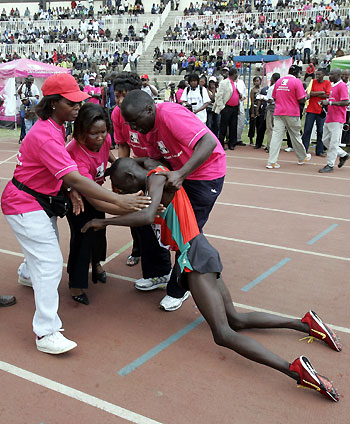
Meanwhile at Nairobi Airport...

5,000m silver medallist Sylvia Kibet

Letzigrund this Friday

Zürich, Switzerland - No rest for the weary. Even for a double World champion.

Just five days after completing the first ever 5000m and 10,000m double victory at a World championships, Kenenisa Bekele will return to the track to take care of the next and most immediate item on his agenda: remaining in the hunt for a share of the $1 million ÅF Golden League Jackpot when the six-meeting series resumes on Friday evening at the Weltklasse at Letzigrund Stadium.

After collecting convincing victories at each of the initial four stops on the ÅF Golden League series, Bekele arrived in Berlin as the overwhelming favourite to win his fourth consecutive 10,000m title, which he did in overwhelming fashion. He concluded his unprecedented double – not even his predecessor and mentor Haile Gebrselassie could manage the feat – with a thrilling sprint victory over defending champion Bernard Lagat on the final day of competition.

Despite his busy schedule over the past fortnight, Bekele is certainly confident that he’ll remain in the Jackpot chase after his 5000m outing in Zürich.

“My shape is very good,” he said. “If the weather remains okay on Friday, I want to try to make a good time in Zürich.”

A “good time” means different things to different people. Bekele has run under 12:50 six times indoors and outdoors, more than anyone else in history. He may try to add another performance to that list, but the odds are good that he’ll give his own season-pacing 12:56.23 from Rome a solid chase. But an assault on his own World record of 12:37.35 may be out of reach for the moment.

“After I changed plans in Berlin and doubled at the World championships, the world record will be difficult to achieve,” he said. “But maybe I’ll try.”

When the ÅF Golden League began with the ISTAF meeting in Berlin in early June, the conventional wisdom went something like this: after a difficult double at the World championships, Bekele could find himself under threat in Zürich by a fresh-legged runner ready to take on the spoiler’s role. But after his homestretch performance at Berlin’s Olympic stadium on Sunday, Bekele looks unbeatable at the moment.

The list of potential spoilers on Friday night includes Kenyan Moses Masai, who took bronze in the 10,000m in Berlin and has a 12:50.55 career best; Ugandan Moses Kipsiro, who was fourth in the 5000 in Berlin and has a 12:50.72 best; Kenyan Leonard Patrick Komon, who was third in Rome with 12:58.24; and Kenyan Edwin Soi, who was fourth at the Kenyan Trials over the distance and hasn’t raced since. Newcomer Sammy Mutahi of Kenya could be a factor as well. Just 20, he ran well in the London 5000 to finish second, has clocked 7:33.02 for 3000m this summer, and hasn’t raced since 2 August.

Bekele hasn’t lost a 5000m contest since 28 July 2006, piecing together a 15 race win streak since. On Sunday he showed the world how determined he was to duplicate his Olympic double at the World championships. One of the few items missing from the 27-year-old Ethiopian’s massive trophy case is a perfect record in Golden League competition. That same determination he exhibited in Berlin will certainly be on display again in Zürich.

Bob Ramsak for the IAAF

Wednesday, August 26, 2009

This brings back cold war memories: who could blame them? UPDATED

FALKIRK, Scotland (AP) — Two runners and two hurdlers from Ethiopia were reported missing Tuesday after leaving their hotel before a track and field meet in Scotland.
The four are Betelhem Shewatatek (women's 200 meters), Feleke Bekele (women's 400 hurdles), Hagos Tadesse (men's 400) and Tirehas Haileselassie (men's hurdles).

Scottish Athletics chief executive Geoff Wightman said his organization reported their disappearance to the police.

The Ethiopians were to compete Wednesday in the Falkirk Cup, a meet also featuring England, Ireland and Scotland. The four athletes are not regulars at major meets.

"My colleague actually tried to restrain two of them but they ran off," said Dagmawit Amare, who is part of Ethiopia's team management in Scotland and has been working with Scottish Athletics. "This is such a sad thing to happen for my country and the sport."

UPDATE

The athletes who have vanished in the UK are believed to be seeking asylum, Mirror reported yesterday.

"One of the Africans fled shortly after landing at Heathrow." Another three disappeared from the team hotel before they were due to catch a flight to Edinburgh yesterday, Mirror said adding that two were spotted sneaking out of the foyer by one of the team's managers - "but an attempt to stop them failed." The athletes fled their hotel in London on Tuesday and failed to make a connecting flight to Edinburgh ahead of the Falkirk Cup athletics event, another report by AFP cited officials as having said.

A look on silver for Japan: Yoshimi Ozaki

In an interview immediately after the finish Ozaki was fresh, energetic and full of laughter. Her hair did not even look wet despite the heat. "Up until the 30 km point I just ran my own pace," she said of the back-and-forth pacing of the main pack throughout much of the race. "The real race was only over the last section." Ozaki's silver ties that of her coach Sachiko Yamashita, who was second at the 1991 World Championships in Tokyo.

READ MORE

She is one of many top athletes who train in beautiful Boulder as the Denver Post realizes:
"The Japanese woman who won a silver medal in the marathon Sunday at the world track and field championships in Berlin trained this summer in Boulder.
Coached by 1991 world championships silver medalist Sachiko Yamashita, Yoshimi Ozaki made her third Boulder training camp from June 1 until the second half of July before returning to Japan for final training at sea level."

mzungo.org says: Most of the athletes are missing out on the great hiking that Boulder offers, being just a few miles from the Continental Divide. But that's just one of the many sacrifices they have to make to be the best of the best.

Tuesday is goodie day - win a 2009 USA Track&Field club champs polo shirt!

I know, it's Wednesday already in Rift Valley but French Polynesia is yet to enjoy another beautiful Tuesday sunset.

Well, ok, let's face it, we're late.

But: It still is picture time and - for most of us - summertime! Celebrate the last hot days by sending in either a running photo themed "summer running" for our "Meanwhile in..." series or be part of the "Runner Nerd" series by shooting your running sneakers.

This week up for grabs: a 2009 USA Track&Field club champs polo shirt, no less!


Keep 'em coming at askmzungo@gmail.com until Sunday August 30!

A lot of celebrities at the Champions Run

THE FOLLOWING ARTICLE IS TRANSLATED FROM GERMAN USING GOOGLE TRANSLATOR!

About 8,000 participants took at the weekend in Berlin at 10 kilometers ChampionsRun for recreational athletes, who on Saturday held two hours after the finish of the World Cup marathon at the World Cup Marathon Round with.

In addition to the officially accepted counted 7675 registered participants, many spontaneously Determined part, without the bib. The track was a sightseeing tour through the heart of Berlin and led from the start on Potsdamer Platz, the Brandenburg Gate, Victory Column, John Foster Dulles Allee, Chancellor, Reinhard, Friedrich and Oranienburgerstraße the Museum past the Berliner Dom cathedral and across the street Unter den Linden, the goal at the Brandenburg Gate.

Be the first to the finish Steffen Uliczka came from the SG / Kronshagen / Kieler TB after 30:25 minutes. The World Cup finalists over 3,000 meters hurdle was eliminated a week ago in World Cup lead. Fastest woman was from Portugal Jessica Augusto in 33:49 minutes.

In attendance were some celebrities. Nils Schumann, 800-meter Olympic champion in 2000, came to 35:46 minutes into the goal. The marathon world champion of 1995, Martin Fiz (Spain), was quite brisk, with 32:15 minutes on the road (13.), and the FDP chairman Guido Westerwelle needed 58:03 minutes.

More great pictures of men's marathon at Berlin worlds!

Check out this LINK to find hundreds of great action shots!

 
ShareThis