
Shaheen dominates the 3k
1 SHAHEEN, Saïf Saaeed QAT WL 7:43.44
2 KIPLIMO, Joseph Kitur KEN 7:49.08
3 KORIR, Shadrack KEN 7:49.13
4 VAIL, Ryan USA 7:56.39
5 GABIUS, Arne GER 8:00.47
6 MINCZER, Albert HUN 8:01.70
7 SMAIL, Nouredine FRA 8:07.08
8 GHIRMAI, Filmon GER 8:16.38
9 SNEBERGER, Michal CZE 8:24.50
GET ALL THE RESULTS HERE
Sunday, January 31, 2010
Saturday, January 30, 2010
Shaheen in Germany! Get your exclusive mzungo shirt shipped FOR FREE TO GERMANEE!
 It's about time! Stephen Cherono AKA Saif Saaeed Shaheen AKA سيف سعيد شاهين is back on track!
At mzungo.org we celebrate his return to indoor running with FREE SHIPPING TO GERMANY!
13€ for the Shirt.
Germans, get your mzungo.org shirt now.
Bob Ramsak for the IAAF
Shaheen’s indoor return
From the busy middle and long distance program, one name in particular stands out, that of Saif Saaeed Shaheen, the World record holder in the 3000m Steeplechase. Sunday's outing will mark the first indoor appearance for the 27-year-old Qatari since the 2006 World Indoor Championships in Moscow where he took 3000m silver behind Kenenisa Bekele. Injury has largely relegated the two-time World steeplechase champion to the sidelines since that season, a campaign capped by his stellar 5000m/3000m Steeplechase double at the IAAF World Cup.
His primary opponent looks to be his former compatriot Shadrack Korir of Kenya, the 2007 World 1500m bronze medallist, who has a personal best of 7:35.98 in the 3000m indoors.
The women’s 3000m has the makings of a barnburner as well, with two of history’s four fastest women toeing the line. Meselech Melkamu famously chased Meseret Defar to the line over the distance in Stuttgart three years ago, finishing in 8:23.74, just 0.02 behind her compatriot’s World record. In Karlsruhe she’ll face Russia’s versatile Anna Alminova, the European indoor 1500m champion, who clocked 8:28.49 in Stuttgart last year – also behind Defar.
"To me it is like winning the Olympics today" - Lagat wins historic eighth Wanamaker Mile
 By Joe Battaglia, Universal Sport
In a race that exemplified his mastery of winning tactics, Bernard Lagat ran comfortably behind the leaders before unleashing his trademark kick on the way to a comfortable victory in the Wanamaker Mile at the 103rd Millrose Games. With the victory, Lagat snapped a tie with Eamonn Coghlan of Ireland, who won seven titles between 1977 and 1987.
As he stood on the track waiting for his formal race introduction, Bernard Lagat craned his neck up to the jumbo screens hanging from the rafters and watched a highlight reel of his past accomplishments.
It was perfect fodder to inspire his competitors, but it also served as motivation for Lagat.
"I actually debated whether I should watch it or not," Lagat said. "I decided, ‘You know what? I'm watching this.' I thought it might give me a boost. As I was watching, I noticed the gap right before the finish line and I remembered that I didn't feel so well at that time. I felt a lot better today and I told myself, ‘You're going to do this.'"
In a race that exemplified his mastery of winning indoor tactics, Lagat ran comfortably behind Olympic gold medalist Asbel Kiprop of Kenya before unleashing a kick that was punishing in both the quickness and effectiveness of its execution.
The final lap served as a coronation as the crowd of 11,510 saluted Lagat with a standing ovation as he cruised to an unprecedented eighth victory in the Wanamaker Mile in 3:56.34 Friday night at the 103rd Millrose Games in Madison Square Garden.
With the victory, Lagat snapped a tie with the great Eamonn Coghlan of Ireland, who earned the moniker "Chairman of the Boards" after conquering the famed banked wooden track here seven times between 1977 and 1987. After taking a victory lap, Lagat found Coghlan, who was trackside, and the two shared a warm embrace.
"To me it is like winning the Olympics today," Lagat, a winner of two Olympic medals and seven World Championship medals, said. "I've been coming here since 2001, and today I was signing autographs for kids who I'm pretty sure were not even born in 2001. I love the crowd here. They never say it's too late and leave. They stay every year to the end to watch this race. To me, that's special."
The fans were rewarded for the dedication by another special performance by Lagat.
The Wanamaker Mile: Every generation needs its heroes
 IAN O'RIORDAN writes
Eamonn Coghlan;s immeasurable inspiration and influence is gradually being lost, another reflection of the decline in Irish distance running
WE WERE somewhere outside Providence, driving I-95 South in a Toyota rental, on our way to the Millrose Games in New York. “Do you think he can do it?” Dave asked, from the front seat. I didn’t want to raise expectations and said we’d have to wait and see.
“Of course he can do it,” said Erin, from behind the wheel. “We’re talking about Eamonn Coghlan. In the Garden. Coghlan rules that place. He owns it. Of course he can do it.”
It was the winter of 1993, my junior year at Brown University. Dave and Erin were seniors, and we shared a house off campus, on John Street. We were utterly absorbed in running in those days, and when we heard Coghlan was coming to Millrose we agreed we had to be there. It didn’t matter that Coghlan was running the Masters Mile, not the Wanamaker Mile. He’d still be the headline act. No man over 40 had run a sub-four mile, indoors or out. Although, deep down, I wasn’t sure Coghlan could do it.
“We’re making pretty good time,” said Dave, as we passed the exits for New Haven. Dave was from New York, grew up on Staten Island. Erin was from California. Yet they both knew every bit as much about Eamonn Coghlan as I did. Chairman of the Boards, and no explanation required. Back then, Coghlan was a hero for every young miler in America, the same way he was for every young miler in Ireland. The TV commentaries I’d listened to on Saturday mornings were the same as Dave and Erin had heard live on Friday nights: “Final lap, Wanamaker Mile. And the fans are on their feet. Into the lead goes Marcus O’Sullivan. But here comes Eamonn Coghlan, right on his tail. Look at Coghlan go! And Eamonn Coghlan eases down to the tape. Three-fifty-five!”
We drove into Manhattan at lunchtime, the early February sunshine illuminating the great skyline in all its glory. Dave had it planned that we’d go to the Hop Kee restaurant in Chinatown, down on Mott Street, for the chicken dish, and then hit Ferrara Cafe in Little Italy, just a block away, on Grand Street.
“The best cannoli in New York,” Dave said, and he knew what he talking about.
“I’m getting nervous, man,” he said. “I think Coghlan’s going to do it.”
We parked right next to Madison Square Garden – at $10 an hour – and headed for window booth six. I’d managed to swing three competitor passes, through my dad, who was an old acquaintance of long-time Millrose meet director Howard Schmertz. We were free to sit anywhere, and found a good spot at the final curve. The place was filling up, fast. The Wanamaker Mile was scheduled for 10pm, but the Masters Mile was off at 8.30, and no one was about to miss it.
Coghlan got a standing ovation when introduced. He was wearing a black singlet and shorts, with a small Foot Locker logo, and the number 40 pasted on to his chest. He did own the place. “That’s unbelievable,” I said to Dave. Then they played the Irish anthem. “That’s unbelievable,” said Erin.
For a man of 40, Coghlan looked superbly fit. He’d been training in Florida since Christmas, having come out of retirement just a few months earlier, determined to leave this one last mark on mile history. The fastest mile by a man over 40 was 4:05.39, by the lanky Kenyan Wilson Waigwa, who was now lining up next to Coghlan.
They dimmed the lights, and swept a spotlight around the Garden’s 160-yard oval. The lap counter was set at 11, and after the starting gun came the inescapable sound of the runners thumping on the wooden boards, drowning out the faint background music.
“What’s going on here?” I asked, as Coghlan began to trail off, sluggishly, almost sinking into the track. “2:02 for Waigwa at the half-mile mark,” they declared, and Coghlan was a good 15 metres adrift, suddenly looking every bit his 40 years.
“Man, this is not good,” said Erin. For the first time all day we wondered if we should have left Providence at all.
What happened next remains one of the great displays of indoor running I’ve witnessed. Just as suddenly, Coghlan looked half his age, accelerating around the tight bends like a sports car. He blew past Waigwa, and in front of an adoring crowd of 18,176 breasted the tape, eyes closed, pointing up at the clock: 4:05.95, the fastest mile run indoors by a man over 40. Coghlan had turned back the clock, in many ways, and it was no less a thrill that he hadn’t gone sub-four. Coghlan again ruled the Garden, owned the place.
The Wanamaker Mile, the climax of the night, and a race Coghlan had won a record seven times, was something of an anti-climax in comparison. Marcus O’Sullivan came close to beating Noureddine Morceli, of Algeria, who ran 3:55.06. But as we headed out into the mild winter night, play-acting around Times Square, each of us knew that Coghlan had been the star of the show, the inspiration for several sessions at the Brown indoor track, maybe even the rest of the season.
Deep down, himself, Coghlan believed he could still go sub-four. Three weeks later, back at the Garden, at the US Indoor Championships, he ran 4:01.39. “That might be as good as it gets,” I read in the New York Times. I thought so too.
A year later, during the worst winter in Providence in 30 years, I heard Coghlan was running an indoor mile up in Harvard, as part of a high school meeting. I didn’t think it was worth risking the old Volvo 145 Estate to make the trip. To this day I regret it. Coghlan, at age 41, ran 3:58.15, the 75th sub-four mile of his career. No other man over 40 has done it.
Last night, back at the Garden, at the 103rd staging of the Millrose Games, the Kenyan-born Bernard Lagat set out to beat Coghlan’s record of seven Wanamaker Mile titles. Lagat now runs for the US, and won the race the last five years in succession, plus 2001 and 2003. Chances are he did win a record eight last night. That might even give Lagat some claim on the title Chairman of the Boards, but I doubt it. Coghlan set the reputation of Irish indoor milers in stone, building on the success of Ronnie Delany, and paving the way for the likes of O’Sullivan, Niall Bruton and Mark Carroll. Between the five they’ve won the Wanamaker Mile an incredible 19 times.
The only disappointment about last night’s Millrose Games was the absence of any Irish miler to keep that reputation going. It doesn’t matter if Lagat won or lost; what matters is Coghlan’s immeasurable inspiration and influence is gradually being lost, another reflection of the decline in Irish distance running. Every generation needs its heroes, and when we left New York in the winter of 1993, the three of us felt that inspiration for days and months afterwards, that Coghlan’s life could somehow be our lives.
It never transpired that way, but at least the dream was real and alive.
Wanamaker Mile @ Milrose Games: Lagat vs. Kiprop
 NEW YORK — Bernard Lagat will be gunning for his eighth Wanamaker Mile - and a record held by Irish indoor great Eamonn Coghlan - at the 103rd Millrose Games indoor athletics meeting on Friday.
Lagat won his seventh Millrose mile last year, matching the feat of Coghlan - whose indoor prowess earned him the nickname "Chairman of the Boards". Lagat's challengers will include Kenyan Asbel Kiprop, the 2008 Olympic 1,500m champion.
Lagat holds the third-fastest indoor mile mark in history of 3:49.89, and he holds the mile record at the Millrose Games of 3:52.87, set in 2005.
Kiprop, who was confirmed as the 2008 Olympic 1,500m gold medallist after Bahrain's Rashid Ramzi was stripped of his Beijing title for doping, will have his work cut out taking on Lagat on the tight track at Madison Square Garden.
Watch LIVE on ESPN2 from 8pm EST.
The man Ramaala fears the most: Martin Lel
 Name: Martin Lel
Age: 31
Height: 5ft 7ins
Weight: 54kg
Home: Eldoret, Kenya.
Career Highlights:
PB 2.05.15
London Marathon Winner 2005, 2007, 2008
New York Marathon Winner 2003, 2007
World Marathon Majors Champion 2007
The past...
How did you get into running?
At aged 12, I started to join older friends who were running in school. I was naturally fit as I had to travel 20km to and from school each day and at the weekends I had to help my parents on the farm.
Who were your sports idol growing up?
Kip Keino was the local hero and was very famous Kenyan from my home town.
When did you decide the Marathon was your event?
In 2001 (aged 22) I ran the local half marathon in Eldoret and came 15th. This qualified me to join Dr Rosa’s (famous Kenyan athletic Coach) but, I was always scared of running a marathon. It was until my coach convinced me to run a marathon that I decided to give it a go and then I competed in the Venice Marathon and ran 2 hours 10 minutes.
The present...
Why is marathon running so popular around the world?
It is a race for the strong and much more challenging than a 10km race. The marathon requires commitment in training and you cannot cheat that in a marathon.
The future...
You have already achieved a lot in your career but what are your future aims?
I want to reduce my personal best in the marathon and win an Olympic medal. I was sick in Beijing so fingers cross for London 2012.
When will there be a sub 2 hour marathon?
A few years! New technology in training is coming and advanced body protection will achieve help achieve this.
Will it be a Kenyan?
I hope it’s a Kenyan but, I will stay safe by saying it will be an African! Ethiopians and Kenyan’s keep stealing each others records at the moment so it will be between the two countries, I think.
On London...
What do you enjoy about London?
I will always have an interest in London. The 2005 race was my first London Marathon and I won. They say it is harder to win the London Marathon than the Olympic’s so I am very privileged to have won it three times.
What would you like to do in London Town that you have not experienced before?
Sadly I have only been to London to race and this time I would like travel London and see all the sites after the race. I would also like to see my team Chelsea play.
Why Chelsea?
Last year I was sadly injured before the race and I was receiving treatment from the Chelsea Physio so this time I would like to see the team play!
Virgin London Marathon
What is your favourite part of the Virgin London Marathon course?
You sadly don’t get to admire the sites during the race. However, Tower Bridge is always beautiful (maybe because it is Halfway!) and of course the finish is a beautiful site.
Are you scared before running London?
Ofcourse, when I am scared I know I am confident and ready to run. If you are not scared about London you must be sick!
Do you have any pre race rituals?
Before bed I pray to god to give me the opportunity to run at my full potential. I never ask him to win just to be in good health.
What do you eat the night before a race?
Spaghetti, water and a glass of milk.
Why milk?
Because I’m used to drinking it in training and don’t want to change my routine the night before a race.
When you are hurting in a race what do you think or say to yourself?
I think back to my training and call on my fitness to get me through.
What is your favourite London Marathon race and why?
Winning London in 2008 I achieved a personal best, a course record and beat great competitors including the future Olympic Champion.
After running what would you like to do?
For work I will become a business man of some sort but I will also be helping out an orphanage I am currently raising money for.
What is your funniest story from a London Marathon race?
Sammy Wanjiru (Olympic and London Champion) was in the press conference after the race and a reporter asked him if he was still hungry after winning the Olympics and London Marathon at such a young age? Sammy replied “Well, you know it is a long way and I am a young man, of course I need too eat!”
footnote says: I must say that I have met some dedicated runners in my time but this boy takes the biscuit. He is dedicated not just in training but his whole life. I am going to write a blog next week on Martin and give you a bit more of an insight into his life and training.
mzungo.org says: thanks for that, footnote!
Wednesday, January 27, 2010
mzungo product review: ASICS GEL-DS Trainer 15
 This week one of the most famous and prestigious running shoes arrived at the mzungo headquarter Americas: the latest ASICS GEL-DS Trainer. We know only few long time runners or triathletes who have never set foot in a DS Trainer.
After running in clunky kicks for years, I remember the revelation when putting on my first DS Trainer: it was in Taupo a few days before the 2000 Ironman New Zealand. Back then, it must have been the fourth version or so of the DS Trainer.
From thereon, I continued buying the updates for a few years. What used to be my racing shoe, slowly became my to go-to shoe for daily training. It must have been in 2006 or so, when the DS Trainer and I fell out of love. I had moved on and now spend my runs with slimmer and lighter kicks.
It may well have been partly her fault given that she turned a little beefier while she matured. Call me superficial but when it comes to running shoes, weight does matter. Of course, she continued adding all these fancy new features. But they somewhat didn't do it for me. I wanted her skinny as in the old days. While I could clearly see that I wasn't alone with that sentiment, there were many new potential lovers lining up and ready to take over.
Now that we haven't seen each other for quite some time, I was of course curious how she was doing these days. It felt a bit like a college reunion. Our friends at ASICS sent me her bio before the party:
"While the GEL-DS Trainer® 14 stayed true to this concept, the shoe was essentially re-invented with new tooling elements and a progressive upper construction. The response from fans of the shoe was universally positive. “Why mess with success?” we say. So for 2010, the series will stay the course with only minimal tweaks and some new lightweight materials."
"Lightweight materials" - intriguing. Is she back to her old self?
"What’s New?
Those in the ‘Please don’t change this shoe!” crowd will be happy to hear that the GEL-DS Trainer® 15 will carry over the tooling elements from the prior model. This set-up is a reprise of the near-perfect blend of old specs and new materials. Specifically, the tooling specs (tooling height and base width) match those of the series’ most popular model, the GEL-DS Trainer® 7."
Aaah, the 7. Now we're talking. She is re-inventing herself. The old trick. Gotta love women.

"The Space Trusstic System® improves on the shoe’s midfoot stability and includes the Gender Specific Space Trusstic System® on the women’s model. The forefoot features the DuoSole® outsole that gives the shoe its name; made from with a combination of blown rubber and Wet Grip®. Wet Grip® is partially comprised of organic material (rice husks) and provides a soft, traction oriented road feel along with improved durability. In addition, platform comfort is ensured by a combination of one-density memory foam sockliner and Solyte® 55 lasting material."
Admittedly, I am a bit drowsy after all these fancy ® words. However, "Wet Grip" definitely caught my attention. In the good old days she used to have this sweet forefoot sole that had a tremendous grip. On the track it felt almost like wearing spikes.
"The upper is all-new but maintains the fit features that runner’s loved on the GEL-DS Trainer® 14. This includes a return to the lasting used on the DS Trainer® 7 for a true-to-size fit. The new design maintains an open vamp with minimal overlays to ensure a great fit, while the heel collar heights have been lowered 2mm to prevent irritation. The lacing system follows an anatomically correct path from the top of the instep to the big toe, the integral concept behind ASICS proprietary Asymmetrical Lacing Design. Gilled Mesh on the quarter-panels returns as well. This unique mesh actually pulls air inside the upper during the swing phase of gait, keeping the foot cooler and more comfortable."
Ok. Noted.
"Those that feel uppers don’t contribute to the overall ride of the shoe should think again. Great care was taken on this update to employ lightweight upper materials, an effort that resulted in a half ounce drop in weight to 10.1 oz. This is a remarkable weight for a support shoe and contributes in a big way to the road feel and overall performance. Just another reason why fans of the series will love this update."
She lost some weight. I like that. The fact that she's still on the slightly heavy side - my current shoes weigh half that - is a bit disappointing but she might move into the right direction.
"With the carry-over tooling, this update will to have the responsive but plush road feel that runners love about the GEL-DS Trainer® 14. The Wet Grip® outsole provides a quick, tacky road feel and adds to the overall platform comfort. The upper fits true-to-size and will feel more open through the toe box, while the heel will feel more ‘locked in’. Like the previous version, it is important to remember that this shoe is built on a modified racing last, so the fit will remain relatively narrow."
When I took her out of the box, she indeed felt and looked a bit chubbier than I had hoped. Mind you though, I have been fooling around with skinny race flats mostly recently. Also, at first glance, her looks didn't really blow me away.
However, the moment I started twisting and turning her around, I got it. The lime green parts are very trendy indeed. ASICS clearly is a step ahead of NIKE with hitting the right tone of this colour.
 Things improved further when I had a look at the "Wet Grip". Yes! This is it!
Almost, at least, as only roughly half of the forefoot is covered with it unlike in the distant past. But hey, ASICS seems to acknowledge what was good and maybe they bring more of that back?
Also, the sole seems very durable. This is appreciated as former DS Trainers have suffered in this area.
When I put her on, I knew instantly that the past would not (and maybe could not) be brought back to the present. A very structured ride is not what I am looking for. That said, the more mature DS Trainers will indeed look VERY attractive to the Kayano and 2100er devotees. Meanwhile, the old DS Trainers' sprit will be kept alive in the Speedstars and Banditos. But who knows what the future will really bring? Women never fail to surprise and impress.
mzungo.org says:
 If you can't ever imagine running in a racing flat but you don't want to run the marathon in your Kayanos either, check her out. She might give you that distinct race day feel while always caring for you at the same time.
And you racing flat fanatics out there, who secretly crave a shoulder to lean on from time to time: the ASICS GEL-DS Trainer 15 brings enough lifetime experience to show you things you may have thought never existed.
Get it on Eastbay - free shipping!

When I put her on, I knew instantly that the past would not (and maybe could not) be brought back to the present. A very structured ride is not what I am looking for. That said, the more mature DS Trainers will indeed look VERY attractive to the Kayano and 2100er devotees. Meanwhile, the old DS Trainers' sprit will be kept alive in the Speedstars and Banditos. But who knows what the future will really bring? Women never fail to surprise and impress.
mzungo.org says:
If you can't ever imagine running in a racing flat but you don't want to run the marathon in your Kayanos either, check her out. She might give you that distinct race day feel while always caring for you at the same time.And you racing flat fanatics out there, who secretly crave a shoulder to lean on from time to time: the ASICS GEL-DS Trainer 15 brings enough lifetime experience to show you things you may have thought never existed.
Get it on Eastbay - free shipping!
Wanamaker Mile Number eight for Lagat? An interview
 Peter Gambaccini for RunnersWorld: Does it have any affect on you psychologically that a switch has been made at this late moment and Deresse Mekonnen (Ethiopia's 2009 World Championships silver medalist in the 1500) is out and Asbel Kiprop (Kenya's 2008 Olympic gold medalist) is in? Does that change your out look at all?
Bernard Lagat: Yes it does, absolutely. There are a few things you have to understand about running in the Garden. It's different. It's not a 200-meter track. And so when you look at a guy like Mekonnen, he's short like me, even shorter, if I may say so, so he can run very well on a track like this (in the Garden). But then when you have somebody like Kiprop, he's tall, he might feel a bit different (out there). But you know what? Kiprop is young, and with adrenalin, a new place, his first race in America indoors, he might not even think about all these other things, not even feel like the banks are so steep or the track is too small, 145 meters. But I prepared for them. So I wish Mekonnen was going to be here, because he's always a good runner, and so is Kiprop. We're adding an Olympic champion. At Prefontaine (Classic in Eugene outdoors) last year, he ran a very good time, he ran 3:48. And also we have Andy Baddeley. He beat me at the Fifth Avenue Mile right here in New York (in September), and he ran a great race. And when we look at his results from just this past week, he did incredibly good (a 3:55.64 win at the Armory in New York). His 3:55 is a good time.
When do you see the Garden track for the first time - only at the (pre-race) introduction or do you actually get to warm up before the mile?
BL: You don't even have a chance to practice over there. There's a high school boys' mile, and then straight up to the elite athletes. The only time we get onto the track is just for the introduction (of the milers).
Have you been in Tucson recently, or Flagstaff?
BL: I've been in Tucson all this time. No weather problems. We're training sometimes barechested. We don't have any shirts, and we don't wear all the tights that people wear in the cold weather. It's really a perfect place to train. That's why my friend just moved in from Illinois, because I always brag about Tucson - "hey man what's your temperature there?" And he tells me "oh, it's about five degrees." And I tell him we have 60 or 65 or 70 degrees." That's why I love Tucson.
There's always talk about the large loud crowd at Millrose. When you go to a place in Europe like Karlsruhe or Birmingham, do you get that kind of audience fervor?
BL: I would say yes, we get it. Here, the fans are really close to the track, so you feel the energy and the noise.... But in Birmingham, we get a lot of people out to watch, but they're really farther away from you. So you hear the noise, but it's not like we get over here at the Garden. And the fact that people stay all the way until the last race at Millrose is really important, it's really special. And they always make the Mile one of the last events, if not the last one.... The noise is incredible. It's really there to support us, and that's really important in the Garden.
Last year, when you won your seventh Wanamaker Mile, you weren't absolutely certain you'd be back. Aside from the obvious commercial considerations, what convinced you to come back?
BL: It is just the fact that I want to see if I can win again. Eamonn Coghlan is a great man. I respect him. He's a true gentleman. I'm sure he's going to be here. Every time, when I think about what he did - to run seven, and to win all of them is really a great achievement. And I was able to do that (win his own seventh) last year. What makes me want to come back is that I just want to be that athlete who has won eight of them. I don't take it lightly. It's important, and I have really trained. James (Li) didn't even take a lot of time to convince me to come back here. I remember when I won the sixth, I said in the press conference "okay, I'm coming back next year to see if I can equal it (Coghlan's total)." And then now that I equaled it, I didn't want to say too much because I didn't know how my shape was going to be. I wanted to wait until after Berlin (the 2009 World Championships) to make sure that I'm still fast enough. I can just worry about one thing at a time. After Berlin, I sat down and said "you know what, Millrose Games is going to be it. I'm going to work hard to try and make the eight." And that's why I'm here now.
Last year, you said you were training 40 miles a week, training less as you got older. Are you training longer miles now that you're focusing on the 5000 (for later in 2010)? Has that changed at all?
BL: Yes, it has changed. Right now, we are doing so many miles, and we are trying to do it in such a way that I don't lose the speed. Sometimes, when you make that switch, it's very hard to come back and work on that leg speed which is really essential in the race itself. So we are working on so many miles now. I am able to run 15 miles, 14 miles, 12 miles. My shortest run, actually, is when I'm calling it almost like a day off, six miles. It's a big change. Sometimes we do the hill work. We try not to forget about things like the hill work that makes you strong, and tempo runs that I always like to do. When we combine all this, it's close to 80 miles.
You mentioned this was an important year for you. It's not a championship year, but based on what we've heard, it sounds like you're going to try and do some pretty amazing things in the 5000.
BL: Yes. It's an off year, so my thinking was I want to try and see if I can go up in distance.... I really never had to train well for the 5000. So now we want to try it out, and so Coach Li and myself sat down and said "this is the year that it's going to be important for you, because we want you to run a very good time." We are thinking that in July, we want to able to run about 12:50, and we cannot do that if I train like the 1500-meter guy. Not that I'll be ditching the 1500 altogether, but I'll be doing that as one of the side races. But the focus is going to be the 5k, so that is why I am upping the mileage and making sure I stick to Abdi (Abdirahman, his friend and frequent training partner) most of the time now because he's the man who knows how to run the distance. That's why he's going to be important.
And at the same time I have an 800-meter runner who came from Rend Lake (College in) Illinois. His name is Boaz Lalang, he was on the Olympic team for Kenya, running the eight (800). So while I'm going to use Abdi to train for the 5k, of course I'll be having Boaz as well to get that speed. That's why it's good to have a good training group. And at the same time, these guys will be benefiting as well because when they go into the middle there, when we have hard tempo runs, Abdi's going to get faster and Boaz is going to get strong.
What was it like getting onto the Garden track for your first Wanamaker Mile? What were your impressions?
BL: That (2001) was my first trip to New York. I was getting overwhelmed by the city, more than even thinking about the race. So coming into the race, I didn't even know anything about it or the track, until when we were running, I felt "this one seems a little too slow, it's just too small." And that was the realization after the race; I didn't even know the distance (of the track). I don't know if somebody mentioned it, but it didn't even click in my head that it's going to 145 (meters). I thought it was like 160. The steep banks, those didn't affect me at all.
So I was in there, running and having a good time. And I think I remember running with Mark Carroll (of Ireland), he was one of them, and then Seneca Lassiter, he was in the race. And Seneca was a good friend of mine. We were running so hard. I don't remember much about it.... Coach told me (in 2003) "it's different." That's when I realized you have to run smarter. But I wasn't too smart the year before, because I lost to Laban Rotich. He just passed me toward the end. And it was hard to pass people back. That's what I always know when I come here. I have to be careful not to be in an awkward position. By that I mean, getting to the outside especially while everybody else is kicking, especially the last lap. You cannot catch anybody. You have to be careful. And what's my strategy - which I hope you guys are not going to write.
You had some problems in 2008, but only by your standards. You did win the Olympics Trials in the 1500 and 5000 and you were an Olympic finalist in the 5000. There were some people who wondered if you were going to come back to a high level again - which you obviously did at the World Championships in Berlin. How aware were you of the public perception, which is obviously not one that you shared, since you knew you had something left?
BL: That perception is really in track and field, especially as you get older. They always believe "this guy is going." And it is so sad, because I would talk to James (Li), and he would say that's the perception, when you got toward your 40s, people will always think when you have one bad year, it's like "oh, he's done." Because the history shows that. Even when they get to the 30s, in the distances and middle distances, they tend to go down and never come up. But for me, I knew that I'm better than that. I can actually feel like I'm so strong. I feel like I'm young again.
Even leading up to the Olympics (in 2008), people were asking me "is this going to be your last Olympics? What do you think your chances are?" People were telling me "it must be really hard because this is your third Olympics." But I told people "hey, look back, not too long ago, 2007, I was the (World) Champion in Osaka, nothing's going to change. I'm still feeling the same way." As a matter of fact, I knew how to prepare well now for the Olympics. But then unfortunately, I got the Achilles tendinitis problem on my left ankle, and that shattered everything. But I knew in my mind it was just the Achilles problem; it was not something that was going to stop me from running in Berlin (in 2009). As a matter of fact, I knew all I had to do was walk out again, try and get in Berlin and try to do the best, and I knew I could medal. You always have to walk out and be optimistic and know that you can do this. And I knew that I was going to work hard and be focused in my training. I knew that "you can do this once you put the work down."
Do you have a favorite among your Wanamaker Mile wins?
BL: Yes, 2005, when I ran the (meet) record, 3:52.87. That's when I talked to Howard Schmertz (the Millrose Games Director Emeritus). The night before, he was in hospitality, and I looked at the trophy for the best athlete of the meet (it's the Fred Schmertz Trophy, named for Howard's father). And I asked him "what does somehow have to do to get that, Howard?" And he says "all you have to do is just break the record (Coghlan's 3:53.0). Run fast." So if I broke the record, I would get that." He told me "yes." And I was so excited. Howard told me at the right time, when my shape was incredible. Of all the indoor races I've been in, that was the one where I felt I was in the best shape of my life.
Going into the race, I wasn't so sure if I could really get it (the record). Looking at the time, to run 3:52 was really hard, because it's the (Garden) track. Knowing it in your head puts some limitations in your preparation mentally. But then I went for it. I wasn't even sure I was on the record but then in the middle of the race, I knew it. we were just running so fast. And I think they were mentioning "he's on the record" and I thought "okay, let me keep going." I felt strong as well. So I got it, and I took home the trophy. So that was really the best one.
That race gave me confidence. That same year, James and I thought "do you think I can get that world (indoor) record, 3:48?" And James told me "hey, why not try it?" I said "let's go"... James talked to the people in Arkansas (at the Tyson Invitational in Fayetteville) and they said "okay, we can set it up for Lagat." And they really set it up for a world record pace. And I ran 3:49. So I missed it by a little bit. But it was a really good year, thanks to the motivation that I got from the Garden here.
How do you compare your fitness this year to 2005, when you set the Wanamaker Mile record?
BL: Similar. Before I came here, I was asking Coach Li the same question - "what do you think of me now," which I rarely ask him. I think he even said "whoa, why do you ask that," because I normally don't ask Coach Li, I wait for him to tell me "man, you're looking really good this time." Since he didn't say anything, I guess he didn't want me to feel "oh man, I'm the best right now." Coach Li sometimes goes slowly and watches what he says. So I asked him "hey coach, what do you think," and it was after the workout just a few days ago. And he told me "man, you know what? You're looking really good this year. Of all the years that you've run indoors, I think that you are well-prepared this time around." And because of the workouts I've been able to do, compared with the workouts that I even did three years ago, this is the fastest that I've run the 400 in the workouts at this time of the year. I was able to run 54, after doing 800s and another 400. Then the last 400 was in 54 and I felt really good. Then we did a time trial before I came over here of 600 meters, and I ran 1:20. So I've never run all those (times) in mid-January before. And I don't labor much. And that's why Coach Li is very pleased with it. He thinks the trick is maybe the workload, going to the miles and hills.
I really want it so bad. I just want to win this eighth one. And I'm glad Asbel is here and Andy Baddeley is here. They're going to make it go fast. I like running under pressure and when I look at those guys, they are not easy guys. They have beaten me before. So sometime you have not fear but uncertainty - "I might lose today, am I really going to run today?" That drives me crazy in the race, so I think I like that myself.
Since you're going to be focusing on the 5000 outdoors, how much does it mean to you that two other Americans have recently gone under 13:00?
BL: That is really beautiful. Let me start with the (American) recordholder. We have Dathan Ritzenhein and then we have Matt Tegenkamp. Those guys have run really, really well. I remember watching both races ... I saw Dathan run, and he looked so easy, really, really easy. If he tells you he was hurting, it's hard to understand to believe it. But of course he doesn't say that, because he looked so relaxed. And the way he did it made me feel "wow, this is good." These guys are raising the bar. I like the fact that I have two countrymen who have run faster than me.And that alone adds something in my ambitions of what I should do. So I'm so ambitious now. For this year, I want to run as fast as those guys if not faster.
Looking ahead to next weekend (Boston on February 6), what does all this training mean for a 5000 now?
BL: First of all, I've not run an indoor 5k. I've been preparing for the mile but at the same time training for the longer stuff. I think it's going to be a really good test. I'm going to be testing myself on really, is this working? And I think it's going to be working out .... When I go to Boston and do all those laps, I know it's not going to be as fast as the mile, but it's going to be steady and strong. I don't know how it's going to turn out, but the preparation is there.
The American indoor 5000 record is 13:18. Do you think there's a shot of getting it in Boston?
BL: I don't know. I haven't really thought about the record. I know it's 13:18. I'm just going to run. I really hate to say "hey, I'm going to run for a record" and then disappointment myself and my fans. But if the opportunity comes and it's fast enough, then hey, why not? I will try, to my best.
Are you going to try to go to World Indoors?
BL: Yes. After Birmingham (England, for a 1500) on February 20, I will come back and get ready for Albuquerque (the USA Indoor Championships) and run a 3000.
Shaheen running 3k in Karlsruhe
 Organisers for the IAAF, Karlsruhe, Germany - Two-time World 3000m Steeplechase champion and World record holder Saif Saaeed Shaheen will contest the 3000m at the BW-Bank-Meeting in Karlsruhe, Germany, on 31 January.
The BW-Bank-Meeting, this year celebrating its 26th edition, is the second IAAF Indoor Permit Meeting of 2010.
Sunday's outing will mark the first indoor appearance for the 27-year-old Qatari since the 2006 World Indoor Championships in Moscow where he took 3000m silver behind Kenenisa Bekele. Shaheen has an indoor best of 7:39.77 over the distance, also from 2006.
Injury has largely relegated Shaheen to the sidelines since the 2006 season, a campaign he capped with a stellar 5000m/3000m Steeplechase double at the IAAF World Cup at Olympic Stadium in Athens.
Among his chief opponents will be his former compatriot Shadrack Korir of Kenya, the 2007 World 1500m bronze medallist. Korir has a personal best of 7:35.98 in the 3000m indoors.
organisers have also announced that four-time World 110m Hurdles champion Allen Johnson will return to Karlsruhe. The ageless American, now 38, set the meeting record of 7.38 back in 1995.
mzungo.org says: Shaheen proudly wears his messagefrommzungo shirt - get yours HERE.
Patrick Rizzo hitting Boulder
 WindyCityRunning reports
It’s been a long road for former Schaumburg High School standout Pat Rizzo, but he’s making one more move, hoping this one allows him to take one or two more steps towards his ultimate running goals. At Schaumburg, Rizzo was a multiple all-state runner, who then took his talents to North Central College and racked up multiple all-American honors. From there, Rizzo jumped over to Michigan, competing for the Hansons-Brooks squad, while improving his marathon personal best to 2:15:48 at the Chicago Marathon this past October.
Since then, Rizzo has packed up his bags, looking for a change of scenery. With Olympic-sized dreams, Rizzo now finds himself in Boulder, Colorado. We caught up with Rizzo earlier this month, where he talks in detail about his move to Boulder (while leaving the Hansons-Brooks program), his transition from a college runner to a professional runner and much more.
Catching Up with Pat Rizz0
Windy City Running (WCR): Lets talk about the big move that few people are aware of currently. You’ve decided to part ways with the Hansons-Brooks group and move out west. Could you talk to us about that decision and how you came to it?
Pat Rizzo (PR): I decided earlier this year on a trip home that things were not all rosy in Michigan. I was on a run with some college teammates and one asked me when I got so negative. It was a huge wakeup call and I spent several months trying to reconcile the problem before coming to the conclusion that things could not improve without me moving out of Michigan. I realized that a lot of the negativity and cynicism was stemming from the car accident (term used loosely: a car hit me while I was running) that left me out of most of the 2008 racing season. There was nothing I could do, short of leaving, that was going to improve my opinion of Michigan after the process following that incident.
Another huge element came down to timing. We are, right now, two years out from an Olympic year again. I have always wanted to move to the West and I have always wanted to live at altitude. Most people would agree that it takes about a year before a person can really know if altitude is working for them. This gives me enough time to come down and readjust if it does not work for me, or a whole year to continue benefiting from it if it does work.
A third element is change. I have been training the same general way for almost four years while with Hansons. I felt like I was getting stale with what I was doing. I have not run track since college and have not really taken a stab at lowering some of my PRs in as long. I think there have been a few brief periods where we (Kevin and Keith Hansons and me) have felt I could go run a 28:50 or so given the opportunity, but we never really felt the need given our racing goals longer term. Now I am wanting to get some of those PRs out in the open and when I pop back into my next marathon, be more prepared to be “in it” when I run it.
WCR: With an eye on Colorado, do you have any firm plans yet as to who you’ll be training with, where you’ll be living, who’ll be coaching you, sponsorship, etc.?
PR: I have some ideas on who I want to train with. I actually have a meeting scheduled with another local, Ed Torres, this week to get some input from his experiences out there and any feedback he may have on stuff as well. He is back in Wheeling for a while and I would be an idiot for not tapping into his knowledge and experience, as we are both working toward the same ultimate goals, to be out best.
My living situation in kind of interesting. A friend of mine in Michigan has a high school friend in Boulder who is a pro triathlete looking for a roommate. The other person in their house knows one of my other Hansons teammates from high school as well, though from a different state across the country. It is a small world and this just collided a lot of our small social networks into one.
As for sponsorship, I have nothing definite yet, but I am talking to people in a few directions right now. I will continue representing Brooks indefinitely or until I have another contract. They have been incredibly loyal to me and the other athletes who have gone through the Hansons’ program, so continuing to wear Brooks and represent Brooks is the least I can do to return the favor. That said, I have to make sure that that will not create any conflicts of interest with any person or group I will be training with out in Colorado. The last thing I would want to do is step on any feet or burn any bridges. I’ve had nothing but great experiences with everyone I have worked with up to this point and want to keep it that way.
WCR: How do you feel you’ve changed as an athlete over the past few years, as you’ve made the transition from a star DIII athlete to a rising-star professional athlete?
PR: One very important lesson that my brother taught me when I was still wrestling was never to give up a match based on what someone else had done in the past. I apply this to my running just as much as I did on the mat. My brother went on to be a 1:50 half miler and 2 x DIII runner-up in the 800m (12 x All-American) and raced with this same mentality and approach. Anyone who wanted to beat him had to earn it. I admired that and as much different as we became as athletes–him in the 800 and me in the marathon–he continues still to be a great teacher when it comes to running.
The reason why I have to introduce it like that is because he is a large reason I continued to progress after college. When I was in high school, he acted as a “filter” in the recruiting process, always looking out for me when I was being recruited. After college, I had a “real job” and hated it. I told my brother, Tony, that I wanted to continue running and quit work and he told me to do it. His advice was that I would have to move away from Naperville, where I went to college, if I ever wanted to “leave” college running.
Although I still have a fantastic relationship with my college coach and teammates, Tony was ultimately right. I needed to surround myself with people who look at a 29:38 PR for a 10k and do not flinch. I also needed to find someone who knew better than me how to train for a marathon. That led me to Hansons, where I spent almost four years before leaving this month.
I think the key to my always moving forward has been always surrounding myself with forward-looking people. In high school, Jim Macnider would let me be satisfied with a performance all the way until the next day’s practice. Al Carius was the same way in college; Al hates complacency. Now, I am searching for that next level and striving not to plateau anywhere along the way.
WCR: Chicago was obviously a good day for you, finishing in the top ten and running as the second American in the field, while achieving a new PR. What have you been up to since then?
PR: It is hard to say that Chicago was a bad day, but I definitely did not consider it a good day. We’ll put it that way. I thought going in that I was 100% ready on the right day to hit 2:13 high. And sure enough, waking up that morning, it WAS the right day. I felt fine all the way until the gun went off. My legs just were not finding the rhythm that I usually thrive off of. It felt more like running a 26 x mile repeat than it did a marathon. I can not pinpoint what made my legs feel like that, which is the only real frustrating part, but still it was a PR and I have to take it.
Since then, I moved back to Schaumburg to spend the holidays with my family before heading out to Boulder for the next chapter of “the grand experiment” as I call it.
I have also been very aggressively treating my plantar fasciitis that has plagued me since about January (of 2009). I sleep with the Strassburg Sock every night and have a golf ball under my computer desk to grind my arch out on whenever I am otherwise idle. It really sucks to say the least. Right now, my right plantar fascia is tearing off of the heel bone, so it goes without saying that running is pretty painful. Still, I would rather live with the pain than not run. Running is my one bit of sanity in life.
WCR: Any idea on when your next race will be?
PR: I will be running a 30k in Tokyo, Japan that is a sister cities race to the Boston Marathon. They have an athlete exchange program that I am traveling on behalf of in February. After that, I plan to lay low for a while and make the adjustment to a new atmosphere, coach, training, and lifestyle.
I am thinking that I will run some shorter stuff most of the spring and summer, then gear up for a fall marathon. I am not sure which yet. Chicago is always awesome; New York is a World Marathon Major and a course I have not run yet; and Twin Cities is the US Championships next year. Who knows? I guess I have time to decide on that small detail.


Message from Durban: Comrades January Newsletter
 Dear Comrades Runners
First and foremost we hope you and your families had an awesome Christmas and New Year, and that 2010 gives you everything you hope and wish for. I would say, everything that happened in 2009 should just be left there and the door closed. Make a new start in 2010. After all, it is the beginning of a new decade...
CMA News
With the departure of Race Director Renee Jordaan from the CMA, we welcome Johan Van Staden as the Comrades Race Director. Johan has been involved in the sporting industry for many years, and has vast experience within the running fraternity. We wish Johan all the best and we are confident that he will become a valuable asset to the CMA in the years to come.
Katia Jones will be on maternity leave, as she and Zayne welcomed their new son into their family late in December.
Entry Reminder!!!
There will be 2000 spots up for grabs on 30 January 2010, and will only be available through the Mr Price stores. Please note that this is the ONLY Avenue that will be available if you missed out on the previous entry deadlines. Entries will be done on a first come first serve basis, and no correspondence will be entered into. Entries open at 09H00.
Management at Mr Price have agreed to assist the CMA for this purpose as they are one of the countries largest, and most successful retail organisations, with +- 1
 000 stores nationwide, which therefore allows for easy accessibility for all that still wish to enter the 2010 race. Mr Price is also a Comrades sponsor.
What to do on the 30 January 2010 at Mr Price:
Make your way to a Mr Price store. Should there still be spots available, you will be able to hand in and pay for your entry at this point.
The entry system is "live" and therefore once 2000 entries have been received, the system will automatically shut down, and entries will then be closed. In no way will the system be able to be overridden, by a store Manager, or staff member, or any individual within the Mr Price Group, as the CMA has full control over the system.
We would like to request that anyone that misses out on entering Comrades 2010, refrain from abusing, shouting or insulting staff at the Mr Price stores, as they cannot change the fact that entries close.
The CMA would like to thank Mr Price for their assistance in advance, which is greatly appreciated.
2010 Club Details & Qualifying
A friendly reminder to submit your 2010 club and license details to the CMA by no later than 26 April 2010 - please submit these details as soon as possible. The 26 April is also deadline to submit a qualifying time, if you have not already done so. Failure to do this will result in your entry being rejected.
Need to Qualify?
For ease of reference herewith a list of qualifying races from January to mid February.
23 Jan 2010 CapeStorm Red Hill Marathon & 36 km Western Province (WP)
23 Jan 2010 Mealie Marathon Free State (FS)
23 Jan 2010 Volksrust 4-in-1 Mpumalanga (MPL)
30 Jan 2010 Ottosdal Nite Marathon & Half Marathon Central North West (CNW)
30 Jan 2010 Shanduka Coal Middelburg 5-in-1 Mpumalanga (MPL)
30 Jan 2010 The Herald/Remax Friendly City Marathon Eastern Province (EP)
31 Jan 2010 Johnson Crane Marathon & Half Marathon Central Gauteng (CG)
06 Feb 2010 Kloppers/Adidas Festival of Running Free State (FS)
06 Feb 2010 Sasol Marathon & Half Marathon Free State (FS)
13 Feb 2010 Eskom Distribution Northern Region Marathon Mpumalanga (MPL)
13 Feb 2010 Potties 4-in-1 Marathon Limpopo (LP)
14 Feb 2010 Nimas Challenge KwaZulu-Natal (KZN)
14 Feb 2010 Pick 'n Pay Marathon & Half Marathon Central Gauteng (CG)
Info from Nedbank Runners Guide 2010
You may run any Standard Marathon (42.2km), as long as it is an officially organized race, and is a timed event, you may use your finishing time as your qualifying time. Maximum time permitted is 5 hours for a standard marathon for qualifying. A full list of races countrywide is available on www.runnersguide.co.za, or get a copy of Tom Cottrell's, Nedbank Runners' Guide 2010, which is available for purchase at your leading news agents.
Honda is title sponsor of L.A. Marathon with multimillion-dollar deal
 By Lance Pugmire
The Los Angeles Marathon, preparing for its new Stadium to the Sea course and a sellout field of 25,000 entrants, announced Tuesday that it had landed a three-year title sponsorship deal with Honda.
Marathon and Honda officials declined to reveal financial terms.
The auto giant negotiated a "multifaceted" deal "for millions of dollars," according to marathon President Russ Pillar, to create the Honda Los Angeles Marathon -- the first title sponsor in the marathon's 25-year history -- and boost the event's ambition to stamp itself "as a destination race for international participants," Pillar said.
Winners will receive a new Honda vehicle, and the deal also features yet-to-be-announced charitable, community-service and marketing components, Pillar said.
"This year's marathon will be more successful than any in our history," Pillar said. "To secure this significant financial commitment from a title sponsor that stands as one of Southern California's top corporations, it's a validation about what we are accomplishing and what this event's impact is on Southern California."
This year's new course, which will start at Dodger Stadium and end overlooking the Pacific Ocean near Santa Monica Pier, passing through Los Angeles, West Hollywood, Beverly Hills and Santa Monica on the way, has drawn thousands paying the $125 entry fee, Pillar said, and the marathon will cap the field at a sellout figure of 25,000.
"It's going to be great for the runners and the spectators. To see the icons of L.A. on this new route will make the race all the more interesting and enjoyable for everybody involved," American Honda Motor Co. spokesman Erik Widen said.
Honda has served as a presenting sponsor of the race since 1995. Company officials cited the marathon's new ownership, led by Dodgers owner Frank McCourt, the course change and the growing interest in an event "that brings the entire community together," for its decision to increase its investment.
"We have a string belief in the event and where it's heading," Widen said.
Honda's role will include a pre-race expo, celebrations at neighborhoods throughout the race and a finish-line festival at the beach. A philanthropic element will be disclosed in coming weeks, the Honda spokesman said.
Tokyo Marathon Announces Elite Field - Nasukawa and Kipsang Defend
 by Brett Larner
On Jan. 25 the Tokyo Marathon announced its elite field for the race's fourth edition on Feb. 28. Last year's winners Salim Kipsang (Kenya) and Mizuho Nasukawa (Team Universal Entertainment) return to defend their titles.
Tokyo's organizers have done a good job of putting together a solid men's field at the start of the crowded spring marathon season. Kipsang may be back, but the 2:06:48 by Rachid Kisri (Morocco) at last year's Paris Marathon makes him a potential favorite despite a lack of other comparable performances. Six other men in the field have run under 2:08 within the last two or three years, meaning the course record of 2:07:23 should be in danger. Domestic hopes lie with half-marathon national record holder Atsushi Sato (Team Chugoku Denryoku). Sato's 2:07:13 PB against Samuel Wanjiru (Kenya) and Deriba Merga (Ethiopia) in Fukuoka '07 makes him the third-fastest man in the field, and his performances at the New Year Ekiden and National Interprefectural Ekiden earlier this month show he is in excellent shape.
The other major Japanese contenders are 2008 Tokyo Marathon runner-up Arata Fujiwara (Team JR Higashi Nihon) and last year's 3rd placer Kensuke Takahashi (Team Toyota). Fujiwara is wildly inconsistent and impossible to predict, but if he is on he will be up front attacking the leaders. Look for a feature interview with Fujiwara on JRNPremium in mid-February. Takahashi's PB is unimpressive but belies the quality of his performance in gale-force winds at last year's Tokyo. Takahashi made the race last year with a bold move after 30 km and outran 2:04 man Sammy Korir (Kenya) for 3rd. With better weather he should be much faster.
Quite a few men are debuting in Tokyo, and among them three Japanese runners deserve special attention. Naoki Okamoto (Team Chugoku Denryoku) and Satoru Kitamura (Team Nissin Shokuhin), two young pros, were the stars of the domestic circuit in 2009, bringing gutsy, outstanding performances in nearly every race of the year. 25 year old Okamoto, a teammate of Atsushi Sato's, ran very well at last weekend's National Interprefectural Ekiden and looks primed for a good debut. Kitamura ran 28:00.22 at age 21 and will be running his first marathon just weeks after turning 24. He appeared to sustain an injury during the Jan. 1 New Year Ekiden but if he has recovered to full fitness Kitamura could be among the leaders. Takahashi's teammate Yoshinori Oda (Team Toyota) had a strong 2009 and also looks ready for a good debut.
The women's field is somewhat thin, but the biggest challenges to Nasukawa should come from Ethiopian Robe Guta, Russian Alevtina Biktimirova, and Nasukawa's Japan-based Kenyan teammate Julia Mumbi. Akemi Ozaki (Second Wind AC), older sister of 2009 World Championships silver medalist Yoshimi Ozaki (Team Daiichi Seimei) heads the domestic competition in what is reportedly her last marathon before some time off, along with Miyuki Ando (Team Daiichi Seimei), a teammate of Yoshimi Ozaki. Also worth keeping an eye on is Team Shiseido's Yumi Sato in her marathon debut.
2010 Tokyo Marathon Elite Field
Men
Rachid Kisri (Morocco) - 2:06:48 (Paris '09)
William Kiplagat (Kenya) - 2:06:50 (Amsterdam '99)
Atsushi Sato (Team Chugoku Denryoku) - 2:07:13 (Fukuoka '07)
Salim Kipsang (Kenya) - 2:07:29 (Berlin '07)
Charles Kamathi (Kenya) - 2:07:33 (Rotterdam '08)
Gudisa Shentema (Ethiopia) - 2:07:34 (Paris '08)
Teferi Wodajo (Ethiopia) - 2:07:45 (Amsterdam '09)
Tomoaki Kunichika (Team S&B) - 2:07:52 (Fukuoka '03)
Shigeru Aburuya (Team Chugoku Denryoku) - 2:07:52 (Biwako '01)
Masakazu Fujiwara (Team Honda) - 2:08:12 (Biwako '03)
Arata Fujiwara (Team JR Higashi Nihon) - 2:08:40 (Tokyo '08)
Erick Wainaina (Kenya) - 2:08:53 (Tokyo Int'l '02)
Yuzo Onishi (Team Nissin Shokuhin) - 2:08:54 (Biwako '08)
Kazutoshi Takatsuka (Team Komori Corp.) - 2:08:56 (Biwako '04)
Julius Gitahi (Kenya) - 2:08:57 (Tokyo '08)
Aleksey Sokolov (Russia) - 2:09:07 (Dublin '07)
Shinichi Watanabe (Team Sanyo Tokushu Seiko) - 2:09:32 (Berlin '04)
Kurao Umeki (Team Chugoku Denryoku) - 2:09:52 (Berlin '03)
James Mwangi (Kenya) - 2:10:27 (Vienna '07)
Seiji Kobayashi (Team Mitsubishi Juko Nagasaki) - 2:10:38 (Beppu-Oita '09)
Kensuke Takahashi (Team Toyota) - 2:11:25 (Tokyo '09)
Tomoya Adachi (Team Asahi Kasei) - 2:11:59 (Beppu-Oita '08)
Ryo Yamamoto (Team Sagawa Express) - 2:12:10 (Hokkaido '09)
Debut Men
Yoshinori Oda (Team Toyota) - 1:30:07 (30 km)
Kenichi Shiraishi (Team Asahi Kasei) - 1:30:08 (30 km)
Nicholas Kiprono (Uganda) - 1:00:25 (half marathon)
Joseph Mwaniki (Kenya) - 1:01:39 (half marathon)
Naoki Okamoto (Team Chugoku Denryoku) - 1:02:16 (half marathon)
Kiyokatsu Hasegawa (Team JR Higashi Nihon) - 1:02:26 (half marathon)
Satoru Kitamura (Team Nissin Shokuhin) - 28:00.22 (10000 m)
Women
Nuta Olaru (Romania) - 2:24:33 (Chicago '04)
Robe Guta (Ethiopia) - 2:24:35 (Hamburg '06)
Alevtina Biktimirova (Russia) - 2:25:12 (Frankfurt '05)
Mizuho Nasukawa (Team Universal Entertainment) - 2:25:38 (Tokyo '09)
Julia Mumbi (Kenya) - 2:26:00 (Osaka '08)
Akemi Ozaki (Second Wind AC) - 2:27:23 (Hokkaido '09)
Miyuki Ando (Team Daiichi Seimei) - 2:29:07 (Osaka '08)
Kaori Yoshida (Amino Vital AC) - 2:30:58 (Nagoya '08)
Yuka Ezaki (Fukuoka T&F Assoc.) - 2:31:35 (Osaka '07)
Sumiko Suzuki (Team Hokuren) - 2:35:51 (Nagoya '09)
Jing Yang (China) - 2:36:28 (Beijing '09)
Debut Women
Yumi Sato (Team Shiseido) - 1:10:03 (half marathon)
SPORTING MORTALITY
 Butcher's Blog reports
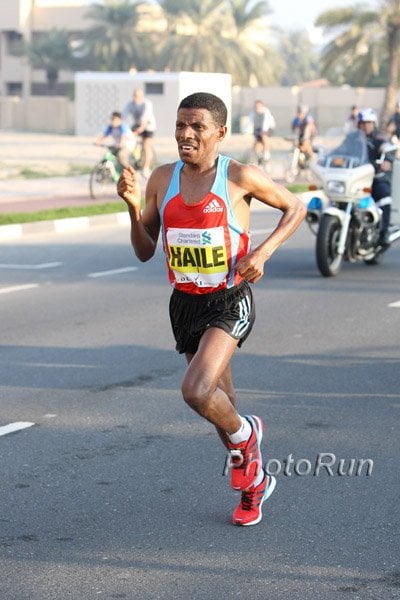
Running, particularly long distance running is one of those unforgiving sports. Unlike, say, tennis and golf, or soccer and other team sports - where sleight of hand or foot can disguise failing power or pace - running is a sport which cannot be faked. There is nowhere to hide.
If you’re not fit, you fail. And even if you are fit, once you start to go downhill it feels, well, it feels like uphill. You can choose your races judiciously, but as you get slower, you cannot fool yourself, for even if the pursuers do not yet overtake, Old Father Time, with his trusty stopwatch is there to remind you.
And ambition can be a cruel master. When Paul Tergat broke the marathon world record, with 2.04.55, in Berlin 2003, it took a while to figure out why he was not elated. It was because pacemaker and pal, Sammy Korir had finished a stride behind him. Tergat wasn’t the only man under 2.05, he hadn’t won by a street, indeed, he had had to work to win by just one second.
Four years later, in 2007, Haile Gebrselassie, the man who had made Tergat’s track career look second-best took the Kenyan’s marathon world record too. On that same Berlin course, he ran close to half a minute faster, with 2.04.26. The following year, again in Berlin, the Ethiopian slashed close to another half minute off the record, with 2.03.59, becoming the only man under 2.04. In the interim, Geb ran 2.04.53 in Dubai 2008. A year later, he won Dubai again, in 2.05.29. He won in Berlin 2009, for the fourth time, in 2.06.08. And now he has won Dubai for a third time, in 2.06.09.
There were good reasons - heat, rain, a back injury - why Haile’s last three marathons were, on average close to two minutes slower than his world record. But there are equally good reasons for thinking that this last record attempt may be a sign of decline. And the first reason was his own demeanour, when your scribe tracked him down several hours after the race in Dubai last Friday.
The smile of greeting was just as broad, and he didn’t look like a man who had thrashed himself around 42.2k, managing to stay ahead of two colleagues, who had caught him after 30k; and who ended up just half a minute behind, his closest pursuers in recent years. But when he was asked for an assessment, the smile was not so broad. It is tempting to say it was tempered by doubt.
He agreed that Chala Dechase (in only his second marathon) had made up ground on him far too quickly. Chala was almost sprinting when he caught Geb approaching 34k. He also maintained that the back injury, provoked by an awkward sleeping position could have forced him out of the race. “I might have dropped out, especially at 30k, I was lucky it was warm here. When the pacemaker left at 30k (32k, actually), I tried to push, but I had no reply. He’s a young boy (Chala), if he’d been more experienced, he would have caught gradually. That was wrong what he did, it was too fast, he should have waited”.
Coincidentally, too fast (at the start) is how Professor Helmut Winter of Humboldt University, Germany characterises Haile’s recent races. Marathon expert Winter, who produced the two fascinating graphs here was in Dubai to see Geb’s latest world record attempt, and says of the second graph, “assume the broken line represents the split needed to run even pace….. The conclusion would be: the 2008WR is a fine race, but for all the other races (Dubai, Berlin2009) this guy (Geb) overpowered himself in the beginning and was lacking substantial reserves in the end. The typical mistake of a BEGINNER!”
(For a breakdown of Geb’s 5k splits, look at the equally interesting piece on The Science of Sport website, www.sportsscientists.com)
Gebrselassie has been written off before, like when he finished third in the world 10,000 metres in Edmonton 2001, his first loss in a 25-lapper in eight years. Or like when he didn’t win the London Marathon in his debut in 2002, or in his two further attempts in London, even dropping out in the latter one. But he came back from Edmonton, and from the London false-start, to set further world records, including eventually the marathon.
But he will be 37 in April. OK, you might say, Carlos Lopes won the Olympic marathon at 37. And Constantina Dita did the same trick at 38. But no one has shown such consistent excellence over such a lengthy period as Gebrselassie, beginning with the world junior 5000/10000 double in 1992, and racking up 27 world records and bests in the 15 years between running 5000m in 12.56.96 in June 1994 in Holland, and the 30k in 1.27.49 that he set during the Berlin Marathon 2009.
He is still adamant he wants to run the Olympic marathon in London 2012, despite his business interests accelerating, eg a new foreign vehicle franchise for Ethiopia, a new hotel complex opening in south Ethiopia in April - friend and former World Cup marathon champion Richard Nerurkar says, “I don’t know how he fits it all in, and trains twice a day”.
Geb’s next race is a half-marathon in New York in March, but he says he has no plans for his next marathon, apart from saying it will probably be in Europe. “I’ve no idea right now. Sometime after September. The Berlin course I like very much. But the big aim is to save my power ‘til London 2012. Until then, two marathons a year, or less. And keep my speed with 10k’s and half-marathons…. As long as I keep my shape”.
He may be suffering the first pangs of sporting mortality, rather later than most of us. But he has already long sewn up the more crucial role - sporting immortality.
Quite frankly, it’s a long walk
 The Nyayo National Stadium must undergo Sh10 million worth of adjustments inside four months to successfully host the 17th Senior Africa Athletics Championship.
The championship’s Local Organising Committee (LOC) on Monday hosted a high profile guest – former Olympic sprints medallist Frankie Fredericks – who is in the country to assess its preparations for the July 28 to August 1 continental meeting.
Fredericks, a World and Olympics sprints silver medallist, is leading an inspection delegation from the Confederation of African Athletics (CAA).
Warm-up track
LOC officials faced a torrid time yesterday as they fielded questions from Fredericks, who is the continental games’ organising delegate.
Although Fredericks did not address journalists, he expressed his satisfaction with the general state of the stadium and some of its facilities, especially plans for a new tartan warm-up track, the doping control room and the mixed zone area.
However, he asked the LOC to rework the media tribune and media centre, and improve the VIP area.
A tartan link between the warm-up track and the competition track is also required, the Namibian legend advised.
Fredericks will make a report to the CAA at the end of his tour and will brief journalists Wednesday.
The Namibian, who is accompanied by the competition’s technical delegate, Vivian Gungaram, and Lamine Faty, the CAA secretary general on the five-day inspection tour, will today study accommodation and transport arrangements.
“The inspection team is here to check the facilities and see what requires adjustment. They are supposed to advise us on how to go about the organisation,” said David Okeyo, the LOC’s chief executive officer.
Benjamin Sogomo, a member of the LOC who is also the chief executive officer of the Sports Stadia Management Board, said his office will be able to make all the adjustments the inspectors require.
From Monday’s inspection, it is clear that the organisers have their work cut out in the field events department after Fredricks voiced his concern over the security of athletes competing on the tartan when the field events are in progress.
Okeyo promised to address his fears urgently. Sogomo also confirmed that some seats will be placed in the 30,000 capacity stadium although not in all areas.
“We will bring in seats for the championships, especially for the VIP deck and adjacent areas,” said Sogomo.
Okeyo said all the 54 African countries invited had confirmed their participation in the five-day meet where places on the African team to the World Cup in Split, Czech Republic, in September, will be up for grabs.
No surprises in Forces cross country
Usual suspects dominated the cross country races as both the police and armed forces held their national championships on Saturday. It was business as usual in the ladies races, although the men pulled a few surprises.
Wanjiru rues missed chance of a record
 By Mutwiri Mutuota
Olympic champion Samuel Wanjiru admitted skipping Berlin World Championships last year may have cost him an opportunity to realise his cherished dream of breaking the marathon record.
Wanjiru, who set an Olympic record (2:06:32) in Beijing, opted to skip the August World Championships to compete at Berlin Marathon a month later aiming at attacking Ethiopia’s Haile Gebrselassie best time of 2:03:59.
When pointed out to him that the World Championship could have been perfect for a world record bid since an almost similar route for the Berlin event was used, Wanjiru said: "Yes, it could have happened there but in events like those, one is scared since you are thinking of the gold medal first then records later. Perhaps we could have worked with my teammates to attack Haile’s record in the flat course."
Contract with Haile
In his absence, Abel Kirui clocked a championship record of 2:06:54 for gold. Wanjiru’s plans to race in Berlin last year were nipped in the bud by reluctance of organisers to enlist him at the event since they had a contract with Haile, who was responsible for selecting the field.
"I will run in London before training to break the world record by 30 seconds in Berlin since running 2:02 is difficult. His (Haile’s) contract with Berlin Marathon is up. Organisers of the event in Chicago agreed that I will race there this year," Wanjiru said on Saturday after finishing 39th (40:32) at the Kenya Police Cross Country championships. His projected new world record would read a jaw dropping 2:03:29!
The London and Chicago marathon course record holder accused Haile of stage-managing his performances by opting to compete against ‘weak’ opposition.
"He does not competing strong runners from Kenya like (Martin) Lel, Robert Cheruiyot and myself. Look at the Kenyans entered in the Dubai Marathon he ran yesterday (Friday)? They are not strong. He has done well on track and marathons and credit goes to him for being the great runner he is, but his time is up. It is the turn of young runners like myself to own the world record."
He added: "After winning gold in Beijing, my only aim is to break the world record. I need strong training partners like Lel and Cheruiyot and I appeal to my compatriots to assist in this attempt. They have been doing it for Haile."
With training bases in Ngong, Nyahururu and Europe, Wanjiru is gearing for the lucrative Lisbon Half Marathon in March and a title defense in London (April) where he ran the 2:05:10 personal best and course record last year before training for his record attempt in Berlin. He plans to feature only in two marathons this year.
Monday, January 25, 2010
BERLIN MARATHON 2010 - Let the battle begin: Wanjiru wants to grab crown from ‘King Haile’
 SUNDAY NATION Correspondent
Ethiopian legend Haile Gebrselassie has run over the cliff and it’s just a matter of time before his 2:03.59 marathon world record is broken.
That was the verdict of Olympic marathon champion, Samuel Wanjiru, after the Ethiopian failed in his third attempt to improve on his record over the 42km distance in Friday’s Dubai Marathon race.
Gebrselassie, who set the world record in Berlin in 2008, was expected to improve it, saying he wanted to run 2:03:30 but could only make it in 2:06:09.
“Haile has really made the difference in marathon running. But he has reached the peak comparing his age and I do not think he is possible to run any faster,” said Wanjiru.
The 23-year-old Wanjiru is optimistic the record can go down by another 30 seconds and believes he can do it at the Berlin City Marathon in September.
“I want the record. It is not beyond human being reach. It can be reduced by another 30 seconds though for it to happen, all the things required must be perfect. The pace setters, weather and form must be optimum,” said Wanjiru.
He has since called upon fellow countrymen Robert ‘Mwafrika’ Cheruiyot, Martin Lel and Abel Kirui - the three marathoners he occasionally trains with - to forgo their individual interests and work together to see that the record returns to Kenya.
Legendary Paul Tergat became the first man to run under two hours and six minutes when he was set a new record in Berlin marathon in 2003 clocking 2:04.54.
“The Berlin course is ideal to break the record. I do not want to put my hope high with London, which is hilly and has sharp corners,” he said.
Wanjiru, who wanted to run in Berlin last year against Gebrselassie but was denied the chance, said he was now focussed on his race in German Capital come September.
“It was not possible for me to run in Berlin last year because Haile had secured a contract that organisers could not bridge. But thank God it’s over and I met them in Chicago and we agreed I will run there,” he added.
Wanjiru, who draws up to Sh19 million ($250,000) appearance fee in most of the races he competes in, could not get the confirmation from Berlin organisers last year that his money would be paid and that is why he opted to run in Chicago.
“They told me it was not possible for me to get the appearance fee. So my manager advised me to run elsewhere and that is why we went to Chicago,” said Wanjiru.
Ever since he started running the 42km marathon race, Wanjiru has only lost once to Lel in London in 2008. He won at the Beijing setting a new Olympic record time of 2:06:32; becoming the first Kenyan to win the Olympic gold in the marathon.
Last year, Wanjiru won both the London Marathon in 2:05:10, a new personal record and also a new course record and Chicago Marathon 2:05:41, the fastest ever marathons recorded in the United Kingdom and United States.
Baddeley and Donohue Win New Balance Games Miles
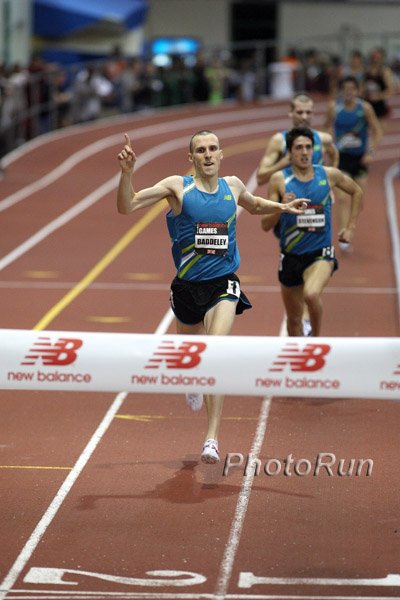 By Peter Gambaccini, Race Results Weekly NEW YORK (23-Jan) -- With the challenge of the Wanamaker Mile at the Millrose Games looming just six days ahead, Britain's Andy Baddeley showed impressive early season form as his 3:55.64 win at the New Balance Games here came close to erasing Mark Carroll's Armory Track & Field Center record of 3:54.98. Erin Donohue was a virtual wire-to-wire winner with her 4:28.92 mile, though she did get a late challenge from an unexpected source. Both athletes set indoor personal bests.
After pacemakers Chris Spooner and Rob Novak peeled off, Baddeley, who won the Continental Airlnes Fifth Avenue Mile here last September, went through three-quarters in 2:58. His triumph was never really in doubt. He did glance back several times "just to see how close they were," but he left the impression that he could have run faster if circumstances required it. Ricky Stevenson (3:56.31) and Mark Draper (3:56.80) made the race a 1-2-3 British sweep. They also ran career best indoor times.
"I'd like to think I did have gears left," Baddeley said of his performance. "I think I can go a bit quicker." He's been forced to do more treadmill training than he'd like during an unusually rough English winter (he's based in Twickenham) but notes that his treadmill is "not too bouncy so it's a bit more realistic."
Baddeley will soon be on his way to altitude training in Australia, followed-up by a 5000-meter race in Melbourne. But first he has that Wanamaker Mile, and New Yorkers may spy the buzzcut Briton training in Central Park this week. It will be his first venture on an 11-lap-to-the-mile track. If he could upset Bernard Lagat and deny him a record eighth Wanamaker triumph "I might tell him I feel guilty, but I think I'd be pretty excited," quipped Baddeley.
Donohue, a 2008 U.S. 1500-meter Olympian from Haddonfield, N.J., led her mile after taking over from pacesetter Lesley Higgins of the New York Athletic Club. After a 3:25 three-quarter split, Megan Wright, who as Megan Metcalfe, won an NCAA 5000-meter title for West Virginia, seemed ready to pounce and possibly poach a victory. But the Canadian Olympian came mysteriously unglued (she faded to tenth, and later smirked "something jumped on me"). Another Canadian, Nicole Edwards, who competed for the University of Michigan, mounted a serious challenge with a move into second place with 300 meters left. But Donohue held on for the victory in 4:28.92, with Edwards a close second in a personal best 4:29.42 and Sarah Bowman, the former University of Tennessee star who is now a New Balance-sponsored professional, third in 4:32.14.
"Fortunately, the speed was still there at the end," observed Donohue, who said her goals for this mile were "to be strong enough and to be able to respond to anyone at the end." She accomplished that. Next, she'll run at 800-meters at the B.U. Terrier Classic in Boston next Friday "to be 100 percent ready to go for the 1000" at the Reebok Boston Indoor Games on Feb. 6.
National Interprefectural Men's Ekiden Hiroshima - report and results
by Brett Larner for JapanRunningNews
click here to read detailed race commentary on JRNLive
 Kensuke Takezawa (Hyogo) outkicks Atsushi Sato (Fukushima) for the win. Click photo for video highlights.
Waseda University graduate and first-year Team S&B elite Kensuke Takezawa (Hyogo Pref.) ran in the image of his coach and mentor Toshihiko Seko, closely tailing half marathon national record holder and fellow Waseda alum Atsushi Sato (Fukushima Pref.) throughout the 13 km anchor leg of the seven stage, 48 km 2010 National Interprefectural Men's Ekiden in Hiroshima on Jan. 24. With 280 m to go Takezawa dispatched Sato with a blazing kick, bringing Hyogo home in 2:20:02 to deliver Hyogo its first National Interprefectural Ekiden win in 3 years and robbing Fukushima of its first-ever National win. "I had a pretty bad year last year," said Takezawa after the race, "so it's nice to get this one off to a good start."
Two-time defending champion and course record holder Nagano Prefecture was the heavy favorite for another win, with 2008 winner Hyogo Prefecture its most likely rival. 3000 m, 10000 m and marathon national record holder Toshinari Takaoka, a guest announcer on NHK's nationwide commercial-free race broadcast, picked Saitama Prefecture as the darkhorse contender. He was right. Saitama Sakae H.S. student Shota Hattori outkicked a pack of high school aces to put Saitama into the lead on the 7 km First Stage. Junior high school student Yusuke Uchikoshi held on to the lead through the 3 km Second Stage, leaving Team Honda's Yoichi Akiyama to try to hold off the competition on the 8.5 km Third Stage.
Behind Akiyama, two university stars made the Third Stage one of the day's highlights. 18 year-old Tokai University first-year Akinobu Murasawa, who set the Interprefectural Ekiden Fifth Stage record last year and then ran 59:08 for 20 km at October's Hakone Ekiden Yosenkai, started 12 seconds behind Akiyama in 4th. Three seconds back in 7th was Hakone Ekiden Fifth Stage star Ryuji Kashiwabara. Kashiwabara went out at full speed, quickly overtaking Murasawa who sped up to run alongside. At one km Kashiwabara clocked 2:36, Murasawa 2:39. That kind of speed couldn't last, but the pair worked together and swiftly reeled in the lead pack of pros and older university runners. It eventually thinned out to a three-way battle between the two young stars and 30 year-old Akiyama, with Murasawa muscling it out in the lead position. In the last km Kashiwabara suddenly went to the verge of vomiting and dropped behind, leaving Murasawa to outsprint the pro Akiyama. Surprisingly, the stage best went to Kashiwabara's former teammate, first year pro Tomoya Onishi of Gifu Prefecture, by one second over Murasawa.
Saitama Prefecture's next two runners, identical twin high school students Yuta and Keita Shitara, retook the lead and opened it to 31 seconds, with Keita taking the stage best on the 8.5 km Fifth Stage. Two runners on the 5 km Fourth Stage, Hirotaka Tamura (Aomori Pref.) and Jun Nobuto (Hyogo Pref.) broke the existing stage record of 14:15. Tamura's time of 14:10 was faster, giving Aomori Pref. its first-ever stage win. Saitama's Sixth Stage runner, junior high school student Kojiro Tomikoshi, lost 13 seconds to Kagoshima's Taishi Sakamoto but held on to an 18 second margin for anchor Takashi Horiguchi. Behind him, Chiba Pref.'s Taiga Machizawa ran a surprise 7-second stage record of 8:31 for the 3 km stage.
Horiguchi, a solid sub-29 minute man, did what he could to keep up front, but behind him it was already all but over. Half marathon national record holder Atsushi Sato (Fukushima Pref.) and 10000 m national university record holder Kensuke Takezawa (Hyogo Pref.) started 40 seconds back and one second apart in 3rd and 4th. With Sato relentlessly pushing forward, Takezawa sat behind him, applying pressure but biding his time in classic Seko style and never drawing even. Together the pair ran down Kagoshima anchor Ryohei Nakano and steadily cut down the distance to Horiguchi.
With 1.6 km to go it was over for Horiguchi as Sato surged past with Takezawa right on his heels. Just as Seko waited until the last curve of the track to drop Juma Ikangaa at the 1983 Fukuoka Marathon, Takezawa waited until the last 300 m to outkick Sato, gapping him by 3 seconds for the win. Neither Takezawa nor Sato scored the stage best, though, as farther back in the pack 27:38 10000 m runner Yuki Sato (Nagano Pref.), Takezawa's rival throughout high school and university, went from 15th to 4th in 37:12, beating Takezawa's time by a solid 21 seconds but missing the stage record by just 3 seconds. Hometown Hiroshima runner Tetsuya Yoroizaka, who had an excellent run for Meiji University earlier this month at the Hakone Ekiden, deserves special mention for hanging on to Yuki Sato after being passed at 8 km and outkicking him for 4th.
2010 National Interprefectural Men's Ekiden Results
click here for complete results
Stage Best Performances
First Stage - 7 km: Shota Hattori (Saitama Pref.) - 20:12
Second Stage - 3 km: Koki Maeda (Fukuoka Pref.) - 8:39
Third Stage - 8.5 km: Tomoya Onishi (Gifu Pref.) - 24:16
Fourth Stage - 5 km: Hirotaka Tamura (Aomori Pref.) - 14:10 - new stage record
Jun Nobuto (Hyogo Pref.) - 14:14 - new stage record
Fifth Stage - 8.5 km: Keita Shitara (Saitama Pref.) - 24:38
Sixth Stage - 3 km: Taiga Machizawa (Chiba Pref.) - 8:31 - new stage record
Seventh Stage - 13 km: Yuki Sato (Nagano Pref.) - 37:12
Top Team Results
1. Hyogo Pref. - 2:20:02
2. Fukushima Pref. - 2:20:05
3. Saitama Pref. - 2:20:20
4. Hiroshima Pref. - 2:21:00
5. Nagano Pref. - 2:21:00
6. Chiba Pref. - 2:21:06
7. Oita Pref. - 2:21:09
8. Mie Pref. - 2:21:11
9. Kumamoto Pref. - 2:21:16
10. Aichi Pref. - 2:21:45
Third Stage Top Performances
1. Tomoya Onishi (Gifu Pref.) - 24:16
2. Akinobu Murasawa (Nagano Pref.) - 24:17
3. Ryuji Kashiwabara (Fukushima Pref.) - 24:18
4. Naoki Okamoto (Hiroshima Pref.) - 24:19
5. Fumihiro Maruyama (Oita Pref.) - 24:23
Seventh Stage Top Performances
1. Yuki Sato (Nagano Pref.) - 37:12
2. Kensuke Takezawa (Hyogo Pref.) - 37:33
3. Atsushi Sato (Fukushima Pref.) - 37:37
4. Yusuke Takabayashi (Mie Pref.) - 38:09
5. Hiroshi Yamada (Tokyo Pref.) - 38:11
6. Ryo Yamamoto (Kyoto Pref.) - 38:15
6. Toshikazu Kawazoe (Kumamoto Pref.) - 38:15
8. Tetsuya Yoroizaka (Hiroshima Pref.) - 38:17
8. Takuji Morimoto (Tottori Pref.) - 38:17
8. Tsuyoshi Ugachi (Tochigi Pref.) - 38:17
11. Hiroyuki Ono (Gunma Pref.) - 38:18
12. Kenichi Jiromaru (Oita Pref.) - 38:22
13. Kazuyoshi Shimosato (Ibaraki Pref.) - 38:23
13. Makoto Tobimatsu (Saga Pref.) - 38:23
15. Takashi Horiguchi (Saitama Pref.) - 38:32
click here to read detailed race commentary on JRNLive
Kensuke Takezawa (Hyogo) outkicks Atsushi Sato (Fukushima) for the win. Click photo for video highlights.Waseda University graduate and first-year Team S&B elite Kensuke Takezawa (Hyogo Pref.) ran in the image of his coach and mentor Toshihiko Seko, closely tailing half marathon national record holder and fellow Waseda alum Atsushi Sato (Fukushima Pref.) throughout the 13 km anchor leg of the seven stage, 48 km 2010 National Interprefectural Men's Ekiden in Hiroshima on Jan. 24. With 280 m to go Takezawa dispatched Sato with a blazing kick, bringing Hyogo home in 2:20:02 to deliver Hyogo its first National Interprefectural Ekiden win in 3 years and robbing Fukushima of its first-ever National win. "I had a pretty bad year last year," said Takezawa after the race, "so it's nice to get this one off to a good start."
Two-time defending champion and course record holder Nagano Prefecture was the heavy favorite for another win, with 2008 winner Hyogo Prefecture its most likely rival. 3000 m, 10000 m and marathon national record holder Toshinari Takaoka, a guest announcer on NHK's nationwide commercial-free race broadcast, picked Saitama Prefecture as the darkhorse contender. He was right. Saitama Sakae H.S. student Shota Hattori outkicked a pack of high school aces to put Saitama into the lead on the 7 km First Stage. Junior high school student Yusuke Uchikoshi held on to the lead through the 3 km Second Stage, leaving Team Honda's Yoichi Akiyama to try to hold off the competition on the 8.5 km Third Stage.
Behind Akiyama, two university stars made the Third Stage one of the day's highlights. 18 year-old Tokai University first-year Akinobu Murasawa, who set the Interprefectural Ekiden Fifth Stage record last year and then ran 59:08 for 20 km at October's Hakone Ekiden Yosenkai, started 12 seconds behind Akiyama in 4th. Three seconds back in 7th was Hakone Ekiden Fifth Stage star Ryuji Kashiwabara. Kashiwabara went out at full speed, quickly overtaking Murasawa who sped up to run alongside. At one km Kashiwabara clocked 2:36, Murasawa 2:39. That kind of speed couldn't last, but the pair worked together and swiftly reeled in the lead pack of pros and older university runners. It eventually thinned out to a three-way battle between the two young stars and 30 year-old Akiyama, with Murasawa muscling it out in the lead position. In the last km Kashiwabara suddenly went to the verge of vomiting and dropped behind, leaving Murasawa to outsprint the pro Akiyama. Surprisingly, the stage best went to Kashiwabara's former teammate, first year pro Tomoya Onishi of Gifu Prefecture, by one second over Murasawa.
Saitama Prefecture's next two runners, identical twin high school students Yuta and Keita Shitara, retook the lead and opened it to 31 seconds, with Keita taking the stage best on the 8.5 km Fifth Stage. Two runners on the 5 km Fourth Stage, Hirotaka Tamura (Aomori Pref.) and Jun Nobuto (Hyogo Pref.) broke the existing stage record of 14:15. Tamura's time of 14:10 was faster, giving Aomori Pref. its first-ever stage win. Saitama's Sixth Stage runner, junior high school student Kojiro Tomikoshi, lost 13 seconds to Kagoshima's Taishi Sakamoto but held on to an 18 second margin for anchor Takashi Horiguchi. Behind him, Chiba Pref.'s Taiga Machizawa ran a surprise 7-second stage record of 8:31 for the 3 km stage.
Horiguchi, a solid sub-29 minute man, did what he could to keep up front, but behind him it was already all but over. Half marathon national record holder Atsushi Sato (Fukushima Pref.) and 10000 m national university record holder Kensuke Takezawa (Hyogo Pref.) started 40 seconds back and one second apart in 3rd and 4th. With Sato relentlessly pushing forward, Takezawa sat behind him, applying pressure but biding his time in classic Seko style and never drawing even. Together the pair ran down Kagoshima anchor Ryohei Nakano and steadily cut down the distance to Horiguchi.
With 1.6 km to go it was over for Horiguchi as Sato surged past with Takezawa right on his heels. Just as Seko waited until the last curve of the track to drop Juma Ikangaa at the 1983 Fukuoka Marathon, Takezawa waited until the last 300 m to outkick Sato, gapping him by 3 seconds for the win. Neither Takezawa nor Sato scored the stage best, though, as farther back in the pack 27:38 10000 m runner Yuki Sato (Nagano Pref.), Takezawa's rival throughout high school and university, went from 15th to 4th in 37:12, beating Takezawa's time by a solid 21 seconds but missing the stage record by just 3 seconds. Hometown Hiroshima runner Tetsuya Yoroizaka, who had an excellent run for Meiji University earlier this month at the Hakone Ekiden, deserves special mention for hanging on to Yuki Sato after being passed at 8 km and outkicking him for 4th.
2010 National Interprefectural Men's Ekiden Results
click here for complete results
Stage Best Performances
First Stage - 7 km: Shota Hattori (Saitama Pref.) - 20:12
Second Stage - 3 km: Koki Maeda (Fukuoka Pref.) - 8:39
Third Stage - 8.5 km: Tomoya Onishi (Gifu Pref.) - 24:16
Fourth Stage - 5 km: Hirotaka Tamura (Aomori Pref.) - 14:10 - new stage record
Jun Nobuto (Hyogo Pref.) - 14:14 - new stage record
Fifth Stage - 8.5 km: Keita Shitara (Saitama Pref.) - 24:38
Sixth Stage - 3 km: Taiga Machizawa (Chiba Pref.) - 8:31 - new stage record
Seventh Stage - 13 km: Yuki Sato (Nagano Pref.) - 37:12
Top Team Results
1. Hyogo Pref. - 2:20:02
2. Fukushima Pref. - 2:20:05
3. Saitama Pref. - 2:20:20
4. Hiroshima Pref. - 2:21:00
5. Nagano Pref. - 2:21:00
6. Chiba Pref. - 2:21:06
7. Oita Pref. - 2:21:09
8. Mie Pref. - 2:21:11
9. Kumamoto Pref. - 2:21:16
10. Aichi Pref. - 2:21:45
Third Stage Top Performances
1. Tomoya Onishi (Gifu Pref.) - 24:16
2. Akinobu Murasawa (Nagano Pref.) - 24:17
3. Ryuji Kashiwabara (Fukushima Pref.) - 24:18
4. Naoki Okamoto (Hiroshima Pref.) - 24:19
5. Fumihiro Maruyama (Oita Pref.) - 24:23
Seventh Stage Top Performances
1. Yuki Sato (Nagano Pref.) - 37:12
2. Kensuke Takezawa (Hyogo Pref.) - 37:33
3. Atsushi Sato (Fukushima Pref.) - 37:37
4. Yusuke Takabayashi (Mie Pref.) - 38:09
5. Hiroshi Yamada (Tokyo Pref.) - 38:11
6. Ryo Yamamoto (Kyoto Pref.) - 38:15
6. Toshikazu Kawazoe (Kumamoto Pref.) - 38:15
8. Tetsuya Yoroizaka (Hiroshima Pref.) - 38:17
8. Takuji Morimoto (Tottori Pref.) - 38:17
8. Tsuyoshi Ugachi (Tochigi Pref.) - 38:17
11. Hiroyuki Ono (Gunma Pref.) - 38:18
12. Kenichi Jiromaru (Oita Pref.) - 38:22
13. Kazuyoshi Shimosato (Ibaraki Pref.) - 38:23
13. Makoto Tobimatsu (Saga Pref.) - 38:23
15. Takashi Horiguchi (Saitama Pref.) - 38:32
Subscribe to:
Posts (Atom)


 ShareThis