Sunday, October 31, 2010

Marine Corps

With a strong effort just past the 20 mile mark, Air Force 2nd Lt.. Jacob Bradosky broke up a pack of four to win the 35th Marine Corps Marathon Sunday in 2:23:30 seconds.

"I was told to run the first 20 miles with my head and the last six with my heart," Bradosky, "and that works very well."

Janet Cherobon, from Kenya, dominated the women's field, finishing first in 2:42:38. Cherobon ran on course record pace until fading in the final two miles. Gina Slaby was second in 2:46:57 and Erin Moffett took third in 2:50:37.

The 26.2 mile race was run through downtown Washington and parts of neighboring northern Virginia amid heightened security because an unknown gunman has fired shots at U.S. military sites four times in recent weeks, including the Marine Corps museum near Quantico twice.

Ronald Kurui, also from Kenya, finished second in the men's division in 2:23:41, despite tripping and scraping his knee and elbow in the race.

Sean Barrett, a First Lt. in the U.S. Marine Corps, took third in 2:24:08. Barrett, who is scheduled to deploy to Afghanistan in two months, was running his first marathon.

"Wearing the Marine Corps singlet at this race is a great honor," Barrett said. "The crowd gives great support, although that also means you can't let them down."

Defending champion John Mentzer, took fourth in 2:27:01.
SOURCE

Raymond Bett Kimutai breaks Athens Classic Marathon record

By Graham Wood, ATHENS (Reuters) - Raymond Bett Kimutai led a Kenyan sweep and set an event record for the 28th Athens Classic Marathon (ACM) on Sunday as Greece celebrated the 2,500th anniversary of the Battle of Marathon.

The 26-year-old accelerated away from race favourite and compatriot Jonathan Kosgei Kipkorir in the closing kilometres to clock two hours 12 minutes and 40 seconds, inside the previous ACM best of 2:12:42 by Paul Lekuraa in 2008. Edwin Kimutai was third.

The course record is two hours 10 minutes 55 seconds set by Italian Stefano Baldini at the 2004 Olympics.

"This is an amazing feeling for me because it is the first time I have won a marathon," said Bett Kimutai after finishing inside the Panathenaic marble stadium, home of the first modern Olympics in 1896.

"The course is very different to other marathons, with some difficult hills and lots of climbing. It is very tough but it is a great course and a different feeling to run here."

The first woman to cross the line was 29-year-old Lithuanian Rasa Drazdauskaite who also set an ACM record of 2:31:06, beating Russian Svetlana Ponomarenko's 2007 mark of 2:33:19.

The ACM has taken on special significance this year as it is the 2,500th anniversary of the fabled 490 BC run of Athenian messenger Pheidippidis who is said to have run from Marathon to Athens to announce victory over the invading Persian army.

A record 12,500 runners, more than three times the usual amount, took part on Sunday including a record 3,000 Greeks.

The total number of participants, including the 10-km and 5-km races, swelled to 20,500.

Greek Prime Minister George Papandreou was among the runners in the 10-km race.

"Today is a celebration for all of humanity," said Papandreou.

"Greece is running a marathon of its own at the moment and we also hope to finish soon," he added, referring to the country's economic strife.

ACM organisers said they expected to the Greek capital to benefit by an estimated 25 million euros as a result of increased tourism during the celebrations.

NYC bound: Team Portland - p.3

nyrr on livestream.com. Broadcast Live Free

Frankfurt Marathon in pictures: elite and sub-elite


All-time Top10 Men Marathon

1 2:03:59 Haile Gebrselassie ETH 18.04.73 1 Berlin 28.09.2008
2 2:04:26 Haile Gebrselassie ETH 18.04.73 1 Berlin 30.09.2007
3 2:04:27 Duncan Kipkemboi Kibet KEN 25.04.78 1 Rotterdam 05.04.2009
3 2:04:27 James Kipsang Kwambai KEN 28.02.83 2 Rotterdam 05.04.2009
5 2:04:48 Patrick Makau KEN 02.03.85 1 Rotterdam 11.04.2010
6 2:04:53 Haile Gebrselassie ETH 18.04.73 1 Dubai 18.01.2008
7 2:04:55 Paul Tergat KEN 17.06.69 1 Berlin 28.09.2003
7 2:04:55 Geoffrey Mutai KEN 07.10.81 2 Rotterdam 11.04.2010
9 2:04:56 Sammy Korir KEN 12.12.71 2 Berlin 28.09.2003
10 2:04:57 Wilson Kipsang KEN 15.03.82 1 Frankfurt 31.10.2010

Frankfurt: Wilson Kipsang 2:04:57 !

1 1 8 » Kipsang, Wilson (KEN) MH 02:04:57 02:04:57
2 2 7 » Tola, Tadese (ETH) MH 02:06:31 02:06:31
3 3 12 » Chelimo, Elias (KEN) MH 02:07:04 02:07:04
4 4 14 » Sanga, Philip (KEN) MH 02:07:11 02:07:11
5 5 29 » Chepyegon, Daniel (UGA) MH 02:08:24 02:08:24
6 6 40 » Maregu, Terefe (ETH) MH 02:09:03 02:09:03
7 7 42 » Rutto, Ronald (KEN) MH 02:09:17 02:09:17
8 8 4 » Keitany, Elijah (KEN) MH 02:09:19 02:09:19
9 9 25 » Kiplagat, Evans (KEN) MH 02:10:07 02:10:07
10 10 17 » Sugut, Henry (KEN) MH 02:10:43 02:10:43
11 11 33 » Teferi, Balcha Kebede (ETH) MH 02:11:42 02:11:42
12 1 5 » Mandago, David (KEN) M30 02:12:10 02:12:10
13 47 » Keiyo, Josphat (KEN) 02:12:35 02:12:35
14 12 3 » Teimet, Sylvester (KEN) MH 02:13:05 02:13:05
15 13 16 » Bungei, Samson (KEN) MH 02:13:23 02:13:25
16 14 41 » Kurgat, Titus (KEN) MH 02:13:28 02:13:28
17 15 43 » Kiplangat, Terer (KEN) MH 02:13:29 02:13:29
18 16 6 » Kiprop, Francis (KEN) MH 02:13:59 02:13:59
19 2 15 » Asmerom, Yared (ERI) M30 02:14:07 02:14:07
20 3 50 » Andreev, Grigoriy (RUS) M30 02:14:08 02:14:08
21 1 27 » Tandoi, Abraham (KEN) USC-He M35 02:14:11 02:14:12
22 4 34 » Yano, Edwin (KEN) M30 02:14:49 02:14:49
23 5 21 » Wangai, Simon (KEN) M30 02:15:02 02:15:02
24 17 60 » Chepkwony, Richard (KEN) MH 02:15:31 02:15:31
25 18 19 » Kutto, Edwin (KEN) MH 02:15:53 02:15:53

Saturday, October 30, 2010

Meanwhile a few years ago...

The Foam Roller

by Hamish Abbie for NZrun.com
After a long run don’t you just wish there was some way to iron out those tired, achy muscles?

Having a foam roller is like having your own live-in masseuse. They are arguably the most effective and easy-to-use tool available for releasing muscle tension and increasing the range of movement in a muscle. But like most pieces of equipment, if you don’t specifically understand what you are trying to achieve and how to achieve it, then you won’t get the desired results or maximum benefits.

How does Foam Rolling Help You?

Imagine your muscles are rubber bands. If you tie a knot in the band and stretch it to its maximum length,chances are that the band will snap or tear at one of its weakest points - on either side of the knot.

Your muscles constantly get bunched up in knots. They are those nasty points that are tender to touch and that keep you going back to the masseuse’s table.

No matter what your activity, certain muscles will gather tension. If you continue to load these muscles without making an effort to break it down, something will inevitably give. It may be that your posture suffers or possibly you will get joint pain as the bones are pulled out of optimal alignment. If you are lucky you’ll just be afflicted with a muscle strain or tear. There are no guarantees of how you will be affected but I can guarantee you are not going to like it.

Foam rollers are your insurance policy against injury.

Using a foam roller serves as self maintenance. If you care enough about your body and its ability to perform optimally, then you need to regularly maintain it. Muscle pulls, strains and tears can all be avoided by maintaining optimal flexibility and skeletal alignment through regular foam rolling, coupled with a personalised stretching programme. Once you have started using a foam roller you will wonder how you ever got by without it.


Foam Rolling Tips

· Use your foam roller before you stretch as this will release your myo-fascia and promote optimal muscle length when stretching.

· Experiment when using your foam roller, adjusting the foam roller and/or your body position to locate the position that gives you the best response.

· Always roll towards your heart as there is a risk of bursting blood vessels if you roll against venous flow.

· Try to foam roll every time you train using the foam roller as a preventative measure to maintain your range of motion and break down knots before they develop into bigger problems.

· Remember there is no substitute for quality when purchasing a foam roller. Cheap rollers will collapse over time, while a good quality one will be your friend for life.

Taking preventative measures to keep you muscles in good condition could save you a lot of pain and frustration, preventing the onset of common running ailments such as shin splints, plantar fasciitis and ITB syndrome. Being proactive and sensible is the key to a long and rewarding running future.

After Delhi, Kiplagat now seeks world record

DANIEL KOMEN for the Daily Nation
He was branded a new kid on the block when he lined up against some of the world’s best track athletes at the 17th Africa Senior Athletics Championships in Nairobi in July.

This was despite having posted an impressive 3:29.27, season best, in the four-lap 1,500m race earlier.

In Delhi this month, Silas Kiplagat emphatically announced that he was no new kid when he won the Commonwealth Games 1,500m gold medal. Before the race, he had not attracted more than a passing glance.

Yet he had earlier obliterated a classy field, among them Africa 1,500m silver medallist Amine Laalou of Morocco and former Commonwealth Games 5,000m champion Augustine Choge, to win the IAAF Diamond League series in Monaco, where he posted his 1,500m career best.

The victory was no surprise for the dark horse, who donned the national colours for the first time during the Africa Championships at Nyayo Stadium. His glory was long in coming.

As a rookie, Kiplagat had floored seasoned runners and world beaters, among them world cross-country titleholder Joseph Ebuya, Sammy Kitwara and Olympian Nicholas Kemboi, to win the 1,500m final at the New KCC/Athletics Kenya track and field meeting in Eldoret last year.

Kiplagat trains under former world 3,000m steeplechase record holder Moses Kiptanui. World 3,000m steeplechase champion Ezekiel Kemboi, Sammy Kitwara and Olympic champion Brimin Kipruto are his training partners in Eldoret.

Now that he holds the Commonwealth Games 1,500m crown and is ranked among the top 10 on the all-time best, Kiplagat wants to go one better.

“After such a feat, I will just race in the IAAF cross-country Permit Meetings and the local series. I want to run a sub 3:28 in the next season, but I need enough time for this,” says Kiplagat, a Kenya Prisons warder.

In Eldoret last Thursday, he said: “When I saw none of my Prisons colleagues on the winner’s rostrum while our counterparts from Kenya Police and the Armed Forces took all the honour, I had to ensure Kenya Prisons also had a name.”

Kiplagat, a third born in a family of seven, said he harbours no interests in cross-country running and will only use the local meets for build-up ahead of next year’s IAAF World Championships in Daegu, Korea.

Inspired by the world 800m record holder David Rudisha and former 3,000m steeplechase all-time best Moses Kiptanui, Kiplagat now has lofty dreams.

“After the World Championships, I will attempt the world record. But I am aware of the stiff challenge posed by bigwigs Asbel Kiprop, Haroun Keitany and Augustine Choge,” he said.

Although still considered an upstart, Kiplagat has four wins this season. He bagged the Berlin Diamond League (3:30.61), Lile Grand Prix (3:33.50) and Monaco Diamond (3:29.27) series, and finished second (3:31.94) in Rieti behind Olympic champion Asbel Kiprop.

He wound up fourth (3:36.74) in the Africa showpiece in Nairobi before romping to victory at the Commonwealth Games in 3:40.51.

“My running 3:29 tells me that I can run better times. I know it’s possible, because even former world champion Bernard Lagat told me that I can make it. So I will definitely try and see if I can get close to the record.”

As is tradition with most Kenyan runners, Kiplagat overcame numerous hardships before he took up athletics. He came from a poor family of peasant farmers in a poor village in Marakwet.

“I used to hear of Moses Kiptanui and Kipchoge Keino, who still remain my role models. I want to reach the level these great men reached,” he says.

Kiplagat used to trek long distances uphill to Tot Primary School and the experience hardened him for running.

“Since we could not make it home for lunch, we used to carry ugali to school wrapped in leaves. We usually covered 30km to and from school. The practice was quite helpful when the Pokot cattle rustlers raided our villages,” said Kiplagat, who hails from Siboh village in Marakwet East.

He says when Kitwara won the 2008 Tecla Loroupe Peace race in Kapenguria, the whole village celebrated, which motivated him.

“I immediately started to train. Exactly two years later, I won in Monaco and I will ensure that my younger siblings get secondary education. I completed Form Four by the grace of God as our family faced financial limitations,” said Kiplagat.

Cut from a different material altogether, Kiplagat stands out from his running peers. He comes from an area world-famed for producing the best steeplechasers.

They include world champion Ezekiel Kemboi, Olympic champion Brimin Kipruto and three-time world champion Moses Kiptanui, among others.

The alumnus of Chebara High School in Marakwet in 2007 pays glowing tribute to world half-marathon sensation Sammy Kitwara, who inspired him to run.

“Kitwara saw me training at home and offered to take me with him to Eldoret, where I lived with him as I continued training. He provided me with running kit.

I owe my career to him because he brought me from nowhere to where I am now,” said Kiplagat, who had his maiden race as a pace setter for Kitwara in Rotterdam when he posted an impressive 58:58, the sixth best world all-time half marathon mark.

“That Kitwara ran 58:58 and we live together, sleep together in one room, eating the same food and training together was a huge motivation. It was great encouragement especially to my age,” says Kiplagat, 22.

Kiplagat was forced to terminate a contract with Dutch track and field manager Frans Denissen, who wanted him to concentrate on road races.

FRANKFURT MARATHON - Last years race...

Despite Money, Medals and Records, Gebrselassie Remains Motivated

By JERÉ LONGMAN

Haile Gebrselassie of Ethiopia has no chance of lowering his world record on the tough, undulating course at the New York City Marathon, but that does not mean he is finished, even at age 37, with attempting to limbo under his current mark of 2 hours 3 minutes 59 seconds.

“We have to be realistic; we know there are not that many opportunities left,” said Jos Hermens, his agent from the Netherlands. “But in his mind, he is so competitive, he feels he can run half a minute or a minute faster in ideal conditions and in good health.”

Those attempts would probably come on flat courses in Dubai or Berlin, where he set his current record in 2008. Being the only person to have run 26.2 miles under 2:04 is a stunning, career-capping accomplishment. Gebrselassie has nothing else to prove, what with 26 world records and two Olympic gold medals at 10,000 meters. So what would most urgently motivate him to make another record attempt? Seeing someone else, say, the Olympic champion Sammy Wanjiru of Kenya, break the current record.

“I think if somebody breaks the record real soon, then he will be very motivated before the end to have one more go,” Hermens said. “Even if it came after the Olympics” in London in 2012.

Though he will turn 40 in three years, Gebrselassie has no thoughts of retiring, Hermens said, driven by competition and earnings that can help his various business ventures, including a hotel, a gym and a bank in Ethiopia.

“He still would like to run another 10 years and win Olympic medals and break records,” Hermens said. “I think the guy will still be running at a high level over 40. He loves running. He can earn a living and invest it in all the things he’s doing. He never takes a break. He always trains, even if it’s in a gym, or in the water right after a marathon. He’s doing something every day.”

Another take on whether Gebrselassie has ducked competition in the marathon by attempting to set records in time-trial type races comes from Mary Wittenberg, director of the New York City Marathon.

“I think this has probably been blown out of proportion,” Wittenberg said. “He has a track runner’s mentality. Time, and records, are really important to Haile. I think he has wanted to have more records than anyone else has ever had. So he totally picked that off. Records have been a priority to him and helped set the course of his career. That’s a different question than, is he ducking competition?”

Ritzenhein learned his lessons in New York in 2006

By Joe Battaglia, Universal Sports

Can you talk about your first time running the New York City Marathon?

I took some bruises that first time in 2006. I learned the hard lessons that a lot of people learn at some point in their marathon careers. I completely ran out of gas, just ran out of fuel. The body only has a certain amount of energy in it, and I basically didn't take in enough. Luckily I haven't had to deal with that again. I never thought I would have so much trouble running 6:30 pace for a mile. That's my easy-run pace. It was a struggle just to make it to the finish line. I think I was probably a little-bit naïve and arrogant to think about what it took to run a good marathon. It doesn't sound hard to run just under five-minute miles but it is a lot harder than I thought it was originally.

Knowing that the marathon is the king of the distances, how did you get sucked into the trap of thinking that running 4:55 pace for 26.2 miles was going to be easier than it seems?

I think it's because the training for the marathon is so moderate. For me, I go and do tempo runs at 4:40 a mile and do that for 13 or 14 miles. You figure, ‘Slowing down that much, it won't be that hard.' That's the thing about the marathon. It's not that hard until about 18, 20 miles. You have to really hold yourself back - at least that's what you feel like - until you hit that point and then it's like, ‘Wow, I guess I wasn't holding myself back.'

In that 2006 race, where did the wheels fall off the wagon and can you describe what you were feeling at that point?

In 2006, I basically hit the wall right after the 35K mark. I was trying to run a smart race but be competitive. The race got really aggressive coming off the bridge into Manhattan and I had to make the decision to go or stay and I kind of went, and that was a problem. The biggest problem was that I sat about 100 meters off of the pack for a good six miles, maintaining decent contact. But it was like someone drained the life out of me. At one point in the race, right after 35K, it felt like someone just pulled the plug. It was a real struggle to get in. In my subsequent marathons, I was a little tentative I think because of that.

Given what you now know about yourself as a runner and about the marathon, how are you approaching this year's race differently?

For this race I would say my training is quite a bit different because before this I never did anything fast and in all of my other marathons after my first one I had a lot of cramping problems in my calves and hamstrings. I think that was part nutritional, sodium imbalances and stuff like that, and we've worked on that quite a bit. The other part is just not having run anything fast. I started my training slower than race pace and got down to race pace, so it was long and slow and I lacked that muscular component of going out hard and fast.

Do you feel your strong background as a cross-country runner will benefit you and if so, which parts of the course suit you best?

The course is definitely not a fast, easy course so I think that benefits me. I haven't really run on a course like that since the Olympic Trials, and I wasn't really in a good place at that time. Just making it to the line was lucky for me. I was injured going into it and not feeling well, kind of anemic, so I ran well there considering the condition I was in. But I think getting back to one of those tough courses will be good for me. It will be a good test to see if I still have that good cross-country background.

Eddy Hellebuyck the cheater (one of the few caught ones)


An American marathon champion, suspended six years ago from the sport for doping, finally reveals the truth behind the charges—and why he now hopes to redeem himself.

Read the story by John Brant HERE

Friday, October 29, 2010

Meanwhile in Frankfurt...


Picture by Falk Cierpinski 

FRANKFURT MARATHON - Ethiopia VS Kenya

THIS TEXT IS AUTOMATICALLY TRANSLATED WITH GOOGLE TRANSLATOR

On Sunday in the 29th Frankfurt Plays the oldest city marathon in Germany starts should tumble records. By Friday were 977 messages before 11th According to Race Director Jo Schindler, the odds are so good that the stragglers from the previous record of 12 614 runners will be cracked with the. "We want to continue in the international comparison of the first in league play and make a step forward," Schindler said on Friday.

Last year's winner Gilbert Kilwa not start. Tadese Tola of Ethiopia for the "hunted" in the race over 42.195 kilometers (10.00 clock / hr ago). The Africans on Sunday celebrates his 23rd Birthday is continuously since 2002 and despite winning runner-armada of Kenya as a top favorite. His great talent he has for the first time before the victory in the Paris Marathon proved 2010 (2:06,41 hours).

The experts believe Tola, who comes with the recommendation of the victory at the half-marathon in Portugal four weeks ago, to well to break the course record of Kilwa (2:06,14). But the number of hunters is great. Equal to 18 starters come with personal bests under 2:10 at the Main - fewer than five were already under 2:07 hours.

Of the German men is far and wide to see anything or expect even after Martin Beckmann (Leinfelden / Echterdingen) is not arrived in time to form. But the club-mates Spergau Falk Cierpinski and Tobias Sauter go into the race. But for the winner's check of 15 000 €, another 75 000 for a time under 2:06 hours and 5,000 euros extra for the course record, the duo is absolutely out of question.

Also for the women's competition, the same doping and the motto "track record" when about 350 000 spectators are expected along the route. The Kursbestzeit dates from 2005 when the Russian Alevtina Biktimirowa (2:25:12) finished first stormed. Ethiopia's Dire Tune is the first candidate from a group of five women who have already run faster than 2:26 hours. The 25-year-old Tune was 14 days, half-marathon runner-up champion in Nanking (China). The additional premium of 75 000 € will be due at 2:22:30 hours.

"The strategy is to have a great bunch, in which all power and from which the finish may be able to sell two men two women, respectively," the sporting director Christoph Kopp described the efforts of the fastest times on the flat course through the city to undercut the goal on the red carpet in the hall.

FRANKFURT MARATHON - The pride of the Nations!

THIS TEXT IS AUTOMATICALLY TRANSLATED WITH GOOGLE TRANSLATOR

Between the skyscrapers Kenyans run against Ethiopians not only to win, but much more. It's about huge sums of money - and the pride of the runners Nations.

Christoph Kopp, the runner-scene a "knack" in reputed. Often enough the 62-year-olds trained eye or a quick chat in order to investigate, who the crowd of athletes committed by him for the Frankfurt Marathon winner question is from. His secret favorites from the African Armada received for years, the race number seven - and often striking is the chosen one unexpected victory, track record and stormed to a record fee. As last year, Gilbert Kirwa, the eighth Kenyan winner in a row.

Mindful of this year's number assignment is announced for tomorrow, Sunday (start 10 clock) to a changing of the guard to athletes from Ethiopia. The seven with the men Tadese Tola, 22 years, best time 2:06:41 hours in April in Paris, the women Mare Dibaba, 21, 2:25:38 equal to debut in Rome. Just as Dire Tune, 25, are the actual favorite (2:24:40 personal best), they bring good shape and lot of confidence. Tadese Tola celebrates birthday on race day, a victory would be the best present ". And he almost had a break with the Frankfurt history because he has entered in the 29-year history, only once an Ethiopian in the winners list (Nedi Dereje, 1984).

The runners with thin calves are reluctant to talk about the rivalry

Would it be so, the inner anger of the Kenyan elite would be enormous. Finally, it is the third most important German marathon, which could for the first time more than 13,000 participants to bring classical 42.195 kilometers, a lot of money: A winning time at 2:06 hours (men) or 2:22:30 (women) is worth 75,000 euros. to explore the rivalry between the dominant nations, difficult: "They are no ethnic divisions that open up there," says Kopp.

The runners with thin calves and narrow arms, even the most reluctant to talk about it. Also in Frankfurt, most athletes Hotel fumble nervously at the finger nail and press a few thin out phrases in poor English, when asked to do so. "We do not feel good if an Ethiopian is before us. This is a matter of honor "at some point declared the Kenyan Richard Chepkwony that starts without a victory chance. "Ethiopians do not run forward, they just use us," adds Daniel Chebii, a Kenyan pace-makers. Caroline Kilel, in the highland region between Kericho tea fields can-training Topläuferin tell a lot about how the Ethiopian women, she literally attacked from behind. "Their ladies throughout the race only run in my back, and just before the finish it before fall." In Toronto, they have therefore missed the victory last half marathon in Glasgow "I'm from the first kilometer running on ahead, so that they do not may follow. "

The Dutch athlete manager Gerard van der Veen compares the situation with the rivalry between the Germans and the Dutch in football. And: "The problem is, already, that the Ethiopians speak no English and communicate with Kenyans hardly," says the 47-year-old, who therefore takes only Kenyans under contract. "I need to communicate with my runners."

Kenyans and Ethiopians dominate in more than a decade, the marathon sector. More so for men than for women. In the financial world's best list are among the best 40 19 Kenyans and 17 Ethiopians. It is also clear that Haile Gebrselassie has contributed much to the rivalry. Every child in Ethiopia knows the story of his Olympic victories in 1996 and 2000 over 10,000 feet, except as runners duped the Kenyan competition.

Organizers have often had good experiences trying to get to the mutual suspicion of an ongoing mass advantage, which is fed from the inexhaustible reservoir in the Kenyan highlands Eldoret or the region around the high-altitude Ethiopian capital Addis Ababa. Here come from almost all the coupling has recruited for his first class occupied elite field. "The strategy is a great bunch to have that drive in which all and from which perhaps can issue two men respectively two women." The main thing, they run for him to record. No matter from what nation they come from.

Marathon and Victory Records
World record: 2:03:59Haile Gebrselassie (Ethiopia / Berlin)
European record: 2:06:36Antonio Pinto (Portugal / London)
Track record in Frankfurt: 2:06:14Gilbert Kirwa (Kenya)
Jahresweltbestzeit: 2:04:48Patrick Makau (Kenya / Rotterdam)
DLV Jahresbestzeit: 2:17:18Falk Cierpinski (Hall in Dusseldorf)
Boston (April 19) 2:05:52Robert Cheruiyot (Kenya)
London (April 25) 2:05:19Tsegaye Kebede (Ethiopia)
EM Barcelona (1st August) 2:15:31Röthlin (Switzerland)
Berlin (26 September) 2:05:08Patrick Makau (Kenya)
Chicago (October 10) 2:06:24Samuel Kamau Wanjiru (Kenya)

FRANKFURT MARATHON - Cierpinski junior and the other Germans...

THIS TEXT IS AUTOMATICALLY TRANSLATED WITH GOOGLE TRANSLATOR

At the Frankfurt Marathon are the black-red-gold hopes on the classic route at Falk Cierpinski. He may not put the bar on Main is too high. His great goal is London 2012.

Waldemar Cierpinski says in substance, that a marathon runner on a direct route to your destination never succeeded. This is certainly not meant, by any or 42.195 kilometers by secret branches are shorter to allow the traditional long detours, but simply the fact that on this route, only the Patient progress. "Who Marathon in the Elite section at the top will the need for seven or eight years and seriously train hard." The now 60-year-old was supposed to know: Waldemar Cierpinski is - even in the GDR Dress -1976 in Montreal and in 1980 in Moscow Olympic Marathon winner became why the GDR sports reporter Heinz-Florian Oertel days before all the enthusiasm the people in the East "in your face at this recommended to call first-born Waldemar.

Start moving in the direction of fastest

Between the two gold medals, the hero of that time itself has a son: born Falk, 1978. Father and offspring now travel to Frankfurt on Friday for the first time marathon, and Falk Cierpinski, 32, together with his colleagues from the Association Cierpinski, Tobias Sauter, 27, all black, red and gold hope on the classic route.

Of course, the duo against legged African Armada on Sunday (start 10 clock) can never win, "but a start moving towards best time I expect Falk," said Christoph Kopp, the sporting director. "A decent race, a good time," adds Jo Schindler, the race director, "that's a good sign." The demanding tone in their voices can not be ignored, especially since they did not fit that, Martin Beckmann canceled because of alleged mold weakness . Too often, organizers, coaches, sponsors or spectators this year have been disappointed by German long trek learning.

The hope of Halle an der Saale brings a personal best of 2:13:30 - delivered in Berlin 2008. Significant for a runner who hired himself out to 2006 only in the triathlon and duathlon. Meanwhile, Falk Cierpinski has since never gone faster. His pupil was in the midst of the changeover, says Waldemar Cierpinski, "2010 is a year with little intensity marathon-specific training. Our goal is London 2012 - and since we are only at half-time. "

Falk Cierpinski may raise the bar on Main not too high, a "conciliatory annual" he wanted, wanted a "factual race shows he and" not to go over, "lets you know the Halle. Too many negative experiences he had to handle last: bad stitch in the World Cup 2009 in Berlin, a pain about 2:22 hours, space 50, a persistent hamstring injury before the 2010 European Championships in Barcelona, cancel.

The soul needs balm

The father and coach, manager and mentor in one person wishes that his son "Motivation sucks for the extremely serious program in 2011." Three-altitude training camps are planned, one of the same in January in Kenya or South Africa, to "many, many miles at high speed . Waldemar Cierpinski will lead the German marathon as a whole forward, "the new national coach Ron Weigel I am advice." He will follow the event in Frankfurt on the ground.

When the B-squad athlete Cierpinski (annual funding € 500) his own Jahresbestzeit (2:17:18 in Dusseldorf) would significantly undercut that would be a signal in all directions. And if not? For this has to be borrowed in dealing with suffering times very steeled Bundeswehr soldier (Frankenberg site) has a motto of the football. "Like Oliver Kahn has said, 'Next, on and on." That's my motto. "Where the path may lead whatsoever.

FRANKFURT MARATHON - Quotes from Leading Athletes at the Press Conference

VIA runnersweb.com

MEN

Wilson Kipsang (Kenya/2:07:10)
"I was very happy with my marathon debut in Paris. This race in Frankfurt will be a big challenge for me because the field is very strong. Some runners have faster times than me but that's also a challenge. I expect the race to be fast and have set three goals for myself: first of all, I want to run a personal best, then if possible get under the course record (2:06:14) and thirdly I would like to run under 2:06."

Tadese Tola (Ethiopia/2:06:41)
"My preparation has gone very well and I've been running between 180 and 200 kilometres a week in Addis Ababa. My goal is to run under 2:06, perhaps 2:05:30. The likelihood of being the only Ethiopian among a group of Kenyans doesn't bother me at all. Each runner will be trying to win. It's my 23rd birthday on Sunday and I hope I shall have something to celebrate."

Sylvester Teimet (Kenya/2:06:49)
"I had a cold a week ago but feel fine now and am fit and ready. I think that if the weather conditions are good, the course record can be broken. A half marathon split of between 62 and 63 minutes would suit me, that would not be a problem. The rivalry with the Ethiopians is good, we spur each other on and that keeps us running faster."

Wilfred Kigen (Kenya/2:07:33)
A hat-trick of Commerzbank Frankfurt Marathon wins to his credit
"This is the strongest field ever in Frankfurt. But that will be an advantage, it will spur all of us on. After two years of achilles tendon problems I'm now back on course to my best times. I want to run 2:08 on Sunday."

WOMEN

Agnes Kiprop (Kenya/2:26:22)
Defending Commerzbank Frankfurt Marathon champion
"My form isn't as good as last year because I had a calf problem a month ago. But I want to run a personal best on Sunday. I shan't start as quickly as the Ethiopians do. I plan to reach halfway in around 63 minutes. The women's field is very strong this year."

Dire Tune (Ethiopia/2:24:40)
"I want to run a fast time on my comeback to the marathon on Sunday. It's important to me and that's why I decided to run the fast Frankfurt course. Running the World Half Marathon Championships (Dire Tune finished second two weeks ago) was a good test for the marathon. I plan to run a half marathon split of between 70 and 70:30 minutes on Sunday."

FRANKFURT MARATHON - Course map

In 2009 the Kenyan runner Gilbert Kirwa achieved with a time of 2:06:14 the course record. After Berlin Frankfurt is the second fastest Marathon in Germany in the year 2009. The women`s course record is currently 2:25.12, run by the Russian runner Alevtina Biktimirova. The track basically takes course on wide main roads. Its very even, because between the lowest point (89,4 meters above sea level) and the highest point (117,2 meters above sea level) there is only a height difference of 27,8 meters spread over the length of 42195 meters.The first part of the course leads the runners through the city centre of Frankfurt with its fascinating skyline, then to the district of Sachsenhausen, towards the residential area of Höchst and back along the Mainzer Landstraße through the city centre and the trade fair tower into the 'Festhalle' with its red carpet.

FRANKFURT MARATHON - Listen to the Stars of the Race

Listen to the Stars of the Race: Listen to what the big favourites of the Commerzbank Frankfurt Marathon say, when interviewed by Andy Edwards before the race. They are talking about their form and what sort of times we could expect on Sunday.

CLICK HERE TO LISTEN TO WILSON KIPSANG

CLICK HERE TO LISTEN TO SYLVESTER TEIMET

FRANKFURT MARATHON - 19 Men with PBs of sub 2:10 in Sunday’s race

VIA frankfurt-marathon.com

The amazing development of recent years seems set to continue in Sunday’s Commerzbank Frankfurt Marathon. With 19 men featuring personal bests of sub 2:10 and eight of them having run faster than 2:07:15 last year’s world-class course record from Gilbert Kirwa (Kenya/2:06:14) will be targeted. If weather conditions are fine the Commerzbank Frankfurt Marathon could well see its first sub 2:06 time. The event is an IAAF Gold Label Road Race.
Somehow it is an irony that so many runners feature such personal bests, since it is not that long ago that the race eagerly waited for the first sub 2:10 performance. It was not before 2003 and the introduction of Christoph Kopp as the elite athletes’ coordinator that such a time was finally achieved. But since then the men’s winner has always run sub 2:10. Such is the extraordinary development that if a winner should run a 2:08 in good conditions on Sunday it would go down as quite a disappointment. If you take the 15 fastest men’s times ever run in Frankfurt none of these is older than five years. And the average of the ten fastest times ever run has already come down to 2:07:39.6 hours.
While organisers had released names of the men’s elite field earlier the women runners have now been announced. In contrast to the men the women did not quite live up to expectations in the past few years. This is why a much stronger field has been signed for Sunday. The aim is to finally break the five year-old course record set by Russia’s Alevtina Biktimirova (2:25:12). Six runners have been entered with personal bests of sub 2:26. Among them are Ethiopians Dire Tune and Mare Dibaba. Tune has a personal best of 2:24:40 and was the winner of the Boston Marathon in 2008. Just recently she won the silver medal in the IAAF World Half Marathon Championships. Dibaba ran a great marathon debut in Rome, where she finished third with 2:25:38 in March this year. Earlier she had improved Tune’s national half marathon record to 67:13 minutes. Two Kenyans – defending champion Agnes Kiprop (PB: 2:26:22) and Caroline Kilel (2:25:24) – plus Hilda Kibet (Netherlands/2:30:33) could do very well as well.
Meanwhile European champion Zivile Balciunaite (Lithuania) had to withdraw due to illness and former world record holder and world champion Catherine Ndereba (Kenya) can not run because of a foot injury.

Frankfurt Marathon 2009

FRANKFURT MARATHON - ‘Lucky sevens' the ones to watch in Frankfurt

Andy Edwards for the IAAF

Kenya’s Wilson Kipsang delivered an apt summary of the quality of the men’s field for Sunday’s Commerzbank Frankfurt Marathon when he likened the last few days of build-up to awaiting an important academic examination.

The Commerzbank Frankfurt Marathon is an IAAF Gold Label Road Race.

“For me, it’s a great privilege to run with these kinds of guys. When I look at the times they’ve run, I think with my performances for the half marathon and shorter road races, they could spur me on to another level.”

Kipsang admits he learned much from what was nevertheless a highly creditable marathon debut in Paris in April, finishing third in 2:07:10. What was the most important lesson? “I run best with even pace, too much variation makes it harder.” With an impressive half marathon best of 58:59, the Iten-based athlete is confident he can take his performance to another level.

Sharing joint honours as the fastest men in the field with a personal best of 2:06:41 are the Kenyan Elijah Keitany, who set that time as runner-up in Amsterdam in 2009 and Ethiopia’s Tadese Tola. The latter won the Paris title in a lifetime best in April and has plenty of incentive to celebrate his 23rd birthday on Sunday. The winner will collect 15,000 Euros while breaking the course record of 2:06:14, set by Kenya’s Gilbert Kirwa last year, will earn a further 75,000 Euros, making this, the 29th edition of Germany’s oldest marathon, a rich prize indeed.

Tadese Tola makes light of any suggestion that he is a strong favourite, despite being given the number seven to wear by the elite race co-ordinator Christoph Kopp, a traditional recognition as being an athlete to watch in Frankfurt.

“In my country, the number seven doesn’t mean anything in particular. But I think that as Sunday is my birthday, it may turn out lucky for me.”

The leading men’s group are setting their sights on reaching halfway in 1:02:50 which would be a fine base to attack the men’s course record. But if it comes to a close finish in Frankfurt’s glorious Festhalle or Festival Hall, Sylvester Teimet has shown he can time a late run to perfection.

The Kenyan ran his personal best of 2:06:49 to win the Seoul Marathon in March, playing cat and mouse – he took the feline role – with last year’s Frankfurt winner Gilbert Kirwa. Teimet waited till 200 metres from the finish before surging to victory.

“I would do the same thing here on Sunday, wait and then attack. I’ve heard the course is fast and if conditions are ideal, I think I could improve my best by over half a minute, perhaps even break the course record.”

WOMEN

The Frankfurt organisers have made a point of boosting the strength in depth of the women’s field this year. Dire Tune of Ethiopia, champion in Boston in 2008 and deprived by one second of a repeat victory the following year by Kenya’s Selina Kosgei, is the fastest with 2:24:40. Only two weeks ago she won a silver medal at the World Half Marathon Championships in Nanning in China but says Frankfurt has held equal importance in her long term plans.

“Our training has been balanced between the Half Marathon Championships and full marathon. Running the half marathon should help me run well in Frankfurt.”

Tune and her fellow Ethiopian Mare Dibaba - number F7 - share the same coach, Hayi Adillo, who maintains that both have looked equally strong in preparation. That must be impressive indeed, since Dire Tune has requested a pacemaking schedule of 70:30 or even 70:00 at halfway, a comment which startled the assembled press corps but which was confirmed upon second asking.

As with Dire Tune, Mare Dibaba knows that the Ethiopian federation are considering prospects for their marathon squad at next year’s World Championships in Daegu, Korea. As coach Adillo bluntly commented: “They know that if they run under 2:23 here and no-one later runs faster, they’ll have a very good chance of being selected!”

Such a time would smash to smithereens the course record of 2:25:12, achieved by the Russian Alevtina Biktimirova five years ago. Last year’s winner, Agnes Kiprop of Kenya, sounded cautious in response, rating her own prospects of retaining the title as “Maybe 50-50.”

Kiprop, whose best is 2:26:22 from winning in Turin last year, might well draw upon a psychological trick or two. Her training group at home in Iten includes Selina Kosgei, conqueror of Tune by the tightest of margins in the 2009 Boston Marathon. Another member of that group could well spring a surprise on Sunday: Hilda Kibet, Kenyan-born but a Dutch citizen for the past three years, has the endurance pedigree, including a European Cross Country title in 2008, to improve greatly on her marathon best of 2:30:33 for third place in Amsterdam last year.

Nike’s new exploration: Cryotherapy

by DOUG BINDER

Alberto Salazar has always embraced new technology as a way to minimize injuries, stay on target, and gain a competitive edge.

The altitude tent (and altitude training in general). The Alter-G treadmill. The underwater treadmill. Those are some of the examples.

And now, welcome to the world of cryotherapy.

There is a new thing at Nike called a “Space Cabin,” and it is the 21st century’s answer to the ice bath.

Step inside this metallic cylinder and liquid nitrogen-cooled air (say, 170 degrees below zero) rushes in and cools your skin to a chilly 30 degrees, yet penetrates just a half millimeter. You slowly rotate for two and a half minutes, holding your hands up and out of the freeze, wearing socks on your toes, and at least some underwear to cover your privates.

“It feels like walking out into the coldest day of the year, naked,” Salazar said.

Salazar, and Nike, are using this device to cool runners down after workouts. Galen Rupp and Amy Yoder Begley used it last Thursday while I was there. Dathan Ritzenhein (training in Albuquerque last week) was reportedly the first member of the group who agreed to try it.

Ice baths are somewhat painful and lower skin temperature to usually no lower than 50 degrees, according to Millennium Ice representatives on site to supervise training.

The theory behind the cryosauna’s use is that it tricks your body into believing it is in serious danger of freezing. The brain sends signals to the rest of the body to draw blood from the extremities and rush it to the core for protection. After you step out, the blood rushes back out again. The phenomena is said to cause an energy boost and skin rejuvenation. It is said to particularly effective to help heal after surgery.

For the sake of athletes, the cryosauna helps sore muscles recover much faster.

Last June, Tyson Gay reportedly used one of the devices to help alleviate his troublesome hamstring.

When you stand inside the chamber, your head remains above the cold air. It’s not advisable to breath in the nitrogen, lest it put you to sleep.

Cryotherapy already has numerous medical applications.

Athletes who use it may require less down time after workouts, or be able to work harder on back to back days. And it may prevent, or reduce, injuries.

And while there are currently less than 20 of them in the U.S., devices like this are apparently the wave of the future. They’re more common in Europe, where the technology was developed. But some day soon, I’m told, you might find one at your local spa or country club.

Salazar got linked up with the Millenium Ice folks through Tom Shaw, one of the country’s top speed coaches who help NFL prospects prepare for the combine and draft. Shaw is already a big believer.

All sysytems go for Soweto run

The 2010 Soweto Marathon has passed the 1 700 mark in race entries and athletes still wishing to enter for the November 7 road race, can do so at the Maponya and Jabulani Malls in Soweto this weekend.

With a victory purse of R100 000 to the top male and female athlete in the open category, the stakes are high as the country's leading long distance stars are joined by masses of recreational runners out to be a part of one of the favourite events on the Athletics South Africa calendar.

The race will start at 6am at the Rand Show Show Road, Nasrec, with the route taking the field via Madibane High School and Orlando Stadium, past the home of former President Nelson Mandela and past the Hector Peterson Memorial.

It will continue past Winnie Madikizela-Mandela's current home, via Kliptown, Walter Sisulu Square and past the Chris Hani Baragwanath Hospital.

The 10km wheelchair race will start at 6.20am, with the 10km race and 10km walk starting 6.20am and 6.30am respectively. The 5km fun run will commence at 8am.

Athletes who have entered are requested to collect their race numbers between 9am and 7pm from the Athletics SA offices in Houghton on November 3-4 or from the MTN Expo Centre in Nasrec on November 5-6.

Entries fees for the marathon are R80 per athlete, with the 10km (R40), 10km walk (R40), 10km wheelchair (R40) and 5km fun run (R15). Athletes over the age of 60 years will be able to enter free of charge with temporary licence fees for the 42.2km race charged at R30 per athlete and the 10km run or walk at R15 per athlete.

Nairobi marathon: Organisers to take extra security precautions

By CHRIS MUSUMBA

In the wake of security concerns over use of Nyayo National Stadium, organisers of Standard Chartered Nairobi marathon have moved to assure athletes and fans of their safety during Sunday’s race.

Senior Police Superintendent Leonard Katana said adequate security arrangements have been made for cars, athletes and other invited guests.

Katana also announced the closure of several roads ahead of the marathon, which has become the signature annual sports event that brings together runners and supporters from all over the country as well as foreign participants to Nairobi.

“Some roads will be closed from Saturday at 9.00 pm until Sunday 1.00 pm. Sections of Uhuru Highway, Aerodrome Road and Langata Road from the Mbagathi round-about towards Nyayo Stadium will be closed from Saturday at 9pm,” said Katana.

On Sunday morning, Katana said Kenyatta Avenue, Harambee Avenue and Haile Sellassie will also be closed to the public.

Over 15,000 people are expected to compete in the 42km race. This will force diversion of traffic on several roads.

Katana clarified that part of Mombasa Road and Uhuru Highway will be opened to churchgoers.

“For those going to churches along Mombasa and Uhuru Highway, we will have barriers erected on one lane allowing them to access their churches.

“But it will only end at the church and anyone intending to cheat the officials, will not succeed,” said Katana.

NYC bound: Viktor Röthlin

Zürich, Switzerland, Weltklasse reports - European Champion Viktor Röthlin is all set for the 2010 ING New York Marathon on 7 November. The Swiss marathon star had little time to prepare, but was able to complete three test races - two half marathons and a 10-mile run - successfully.

Röthlin is looking forward to running the second marathon of his 2010 season: “I am excited to be able to be in New York and to compete in one of most famous races of the world.”

His preparation for the prestigious competition in the Big Apple - his 20th marathon race - was not the usual routine: “I never had as little time to prepare for a marathon before. Usually, I invest about 14 weeks. This time around, I had to make do with seven. I am actually in the middle of a first training phase, which makes it hard for me to judge where I am at with regard to my shape.”

The course in New York, which includes the city’s Central Park, will suit Röthlin well: “A race with pacemakers and stars focusing on a fast result would not be ideal for me. But New York will be more like a championship race. This will allow me to concentrate on my strengths, my tactics. In addition, I will to gather experience for my next championship race, possibly be the marathon at the 2012 Olympic Games in London,” Röthlin explained.

The New York race will be a highlight for the 36-year-old Swiss: “There is no pressure whatsoever. I like that. I will be able to follow my own agenda. Obviously, Haile Gebrselassie is the top favourite, and he will give it his best to win this famous race.” The rest of the result list remains anyone’s guess. “The final start list will be announced next week. I will think about a goal for my position on the result list then.” Röthlin’s last race in New York was a half marathon in 2007. He came in eleventh then, and the winner of the race was - Haile Gebrselassie.

This Sunday (31 October), Röthlin will do a “depletion run” of 25 kilometres before concluding his preparation with a standard treadmill training session (including a lactate test) at the Sportzentrum Kerenzerberg in the canton of Glarus. He will fly to New York on Wednesday, 3 November 2010.

__________________________________________________________________________________

And here's a let's runner's take on his training methods:

Well, I use his training system. As he claims that he's using it himself, at least the basics should be the same. He says that he is running upto 250km per week and he is doing a lot of additional strength training.

The long runs are run faster than what's common (internet) sense. He uses a "finish strong" approach. (well look like he races the last 5km of a marathon, it pays...)

The fast repetition based speed work (e.g. 200m repetitions) is done before the stamina phase. It belongs to early base-building and is not put near the race-phase (that's a big difference to lets say Lydiard). The number of repetitions and the speed is also (to my concern) more intensive than what you may find in other programs (e.g. Daniels).

Btw: there is no "just cumulating miles/kilometers" phase. Speed, Stamina, VO2max-intervals are always a part of the training (with different priority of course).

For the marathon a lot of long intervals (e.g. 3600m up to 5000m depending on your ability) at around 15k/HM speed is used.
The tempo-runs were somewhat "unusual" when I did them the first time. After warming-up you are asked to run at a very slow pace for around 30-40minutes (making your legs falling into sleep) and then you have to switch to 15k/HM speed for another 25-40minutes. Quite interesting feeling in your legs.

Ok, enough about speed and so on. Another big point are the "normal" runs: For an American the intensity is probably very low. It's partly _far_ below what Karvonen considered to be to point where a run shows effects.
Recovery runs are even more slow (under 65%HRmax).
Victor stresses that this at least as important as the rest of his training-system.

To sum that up: Victor knows NO forbidden zone (see Daniels). In fact he even says that the intensity that other coaches see as a forbidden zone is very important.
He is no friend of cumulating miles at low speed and adding fast intervalls/tempo runs. The "middle" would be the missing point here.

mzungo says: Often, we hear the question: is Roethlin a doper? Here are two articles on the subject (in German):


YES
Nooo!

Make up your own mind.

NYC and Tokyo bound: Haile

Yes, that's correct, Haile G is running the Tokyo Marathon on February 27, 2011.

Dathan Ritzenhein in a NYT story on Haile G (follow link to read the whole story)

NYC bound: Team Portland

Thursday, October 28, 2010

Nairobi Marathon: A LOT more talent than NYC


By CHRIS MUSUMBA, cmusumba@ke.nationmedia.com
Forget the lotteries and mobile phone wars to reward loyalty with money. Sunday will give over 14,000 people who have registered for this year’s Standard Chartered Nairobi International Marathon a chance to become instant millionaires should they win the 42-kilometre road race.

The race, now a permanent fixture in many Nairobi people’s calendars, will be marking its eighth edition. Last year, the race attracted about 13,000 people and has Standard Chartered Bank funding it until 2012. Geoffrey Githinji, the chairman of the race’s Steering Committee, said the organisers have received overwhelming interest from runners, fans and others keen to conquer their individual challenges. The registration process wound up on Tuesday, five days before the race, enabling the organisers to plan well. Race director, John Velzian said, this year’s competition is expected to be easy to organise now that construction on Mombasa road has been finished.

“Registration has been very efficient and we managed to close on Tuesday as scheduled and we are happy to report that the numbers have gone up to 14,000 participants,” said Githinji.

The Nairobi marathon has six races - the 42.2km full marathon, the 21km half marathon, the 10km road race, the Family Fun Run, the wheel chair and the Tricycle race.

Athletics Kenya confirmed yesterday that the marathon will take the same route as last year’s.

This route will see participants start at traditional point at Nakumatt Mega outside Nyayo National Stadium, take Uhuru Highway and turn at the University Way round-about into Kenyatta Avenue, Harambee Avenue and Haile Sellassie Avenue. The athletes will then head back to Mombasa Road and finish inside the stadium.

This route was unveiled last year and saw a course record of 2:10:12 set by last year’s winner Moses Kigen. Irene Jerotich has the women course record time of 2:28:47. A bonus of Sh250,000 if on offer for any woman or man who will beat the course time.

Since it inception in 2003, the marathon has grown to be the largest sporting event in Kenya attracting the highest number of elite athletes out of all the athletics events in the country.

Over the last five years, budding athletes have launched their careers in the Nairobi Marathon, offering an excellent opportunity for these runners to not only run one race of their own but to experience an international meet on their home soil.

The Nairobi marathon has indeed been a talent development opportunity with the like John Kelai and Caroline Kilel, the Commonwealth Games marathon champions, having discovered their prowess in the Nairobi marathon. As usual, the marathon is expected to unearth fresh talent. Last year, debutante Moses Kigen set a course record of 2:10:12 to win the men’s marathon dethroning the 2008 winner Moses Tuiyange who came in second.

In the women’s race, Irene Jerotich became the first second-time winner in the history of Nairobi Marathon with a course record of 2:28:47.

Jerotich erased the previous route best by four minutes and 56 seconds set by Emma Muthoni in 2008.
All proceeds from the Nairobi marathon go towards Seeing is Believing, a Standard Chartered Bank Charity aimed at eradicating avoidable blindness. Last year, Shs14.5 million was raised and went into funding cataract operations in Sabatia, Kikuyu, Tenwek, Kwale and Lighthouse for Christ Eye Centres.

“Last year we raised Sh14.5 million that went into our ‘Seeing is Believing’ initiatives across the country. This year, we are calling on all Kenyans to join and help us reach more Kenyans facing blindness,” said Richard Etemesi, Standard Chartered Bank’s Chief Executive.

mzungo: one day, this race may be the to go to marathon for elites. Until then, it's just the marathon with by far the most talent in one single race. Athletes travel to Nairobi from all over the country. Some of them spend the little they have for buses that drive for hours on rough roads just to get to the start.

Paul Tergat receives Abebe Bikila award

New York, USA, NYRR report - Paul Tergat of Kenya, the winner of the 2005 ING New York City Marathon in the race’s closest finish has been named the recipient of the 2010 Abebe Bikila Award presented by New York Road Runners.

Tergat will be presented with the award before the start of the Continental Airlines International Friendship Run during ING New York City Marathon weekend on Saturday, 6 November.

The Abebe Bikila Award has been presented annually since 1978 to an individual who has made an outstanding contribution to the sport of distance running. It has a glittering list of past recipients, including Bill Rodgers, Alberto Salazar, Fred Lebow, Joan Benoit Samuelson, Grete Waitz, and Paula Radcliffe. Last year’s honoree was past NYRR president and CEO Allan Steinfeld.

Tergat claimed a place in ING New York City Marathon history in 2005 when he edged the 2004 champion, Hendrick Ramaala of South Africa, after a furious sprint to the finish line to win by three-tenths of a second. Tergat returned to New York in 2006 to finish third and in 2008 to place fourth.

Tergat once ruled the IAAF World Cross Country Championships, winning the title for five consecutive years (1995–1999), and in 1998 and 1999 also won the IAAF World Half Marathon on the roads. He is a two-time Olympic silver medallist at 10,000 metres, having finished behind Ethiopia’s Haile Gebrselassie by narrow margins in both Atlanta in 1996 and Sydney in 2000. He took the silver medal in the 1997 and 1999 World Championships at 10,000 metres and in 2003 he set the World marathon record of 2:04:55 at the Berlin Marathon, a time that still makes him the fifth-fastest man in history.

Now 41, Tergat has been effectively retired from competitive racing since 2009 and has turned much of his effort to his work as a goodwill ambassador for the World Food Programme of the United Nations.

“The history of marathon running is incomplete without the solid and indelible mark of the late Abebe Bikila’s contribution, and I am so proud to be associated, through this award, with those who have continued his passion, commitment, and spirit to give marathon running and sports their worthy global prestige,” said Tergat. “Thank you for this recognition and honour. I dedicate this to all marathon lovers and to Kenya.”

mzungo says: Paul is our hero! I will never forget the legendary 2006 NYC Marathon when I had the privilege to warm up in the same area as Paul. He strolled along with two fellow Kenyans. As I jogged past him, I jokingly said "I am passing Paul Tergat!" to which he chuckled and shouted "Weeerrry gooood, weeeery goood!". All friendly and relaxed. I was secretly hoping he would be back to run NYC one final time but if someone deserves a retirement, it's the relentless Paul. THANKS!

Wednesday, October 27, 2010

NYC bound: Mara Yamauchi

After the volcanically caused travel disaster getting to London, this time Mara travels much earlier. 
Read the full story here.

NYC bound: Simon Bairu

Simon wrote the below for the NewYorkTimes
Sometimes it is about the journey and not the destination. The destination for me and my two teammates, Shalane Flanagan and Tim Nelson, is the New York City Marathon on Nov. 7, but Aug. 1 marked the start of our journey.

As we drove along the scenic route from Reno, Nev., to Mammoth Lakes, Calif., to start our six-week training camp, I could sense a feeling of excitement and anticipation within the group. We were about to embark on something completely new, and although nothing in our running careers had specifically prepared us for this journey, everything we had done up to this point in our careers, had prepared us for this moment. To be honest, the marathon didn’t seem overly daunting. We had faith in our coach, Jerry Schumacher, and we knew that regardless of what lay ahead, we would face all obstacles as a team. Our philosophy has always been: It’s us against the world. And New York would be no different.

For Tim and I, preparing for New York would be another shared milestone in our careers, eight years of shared joys and frustrations. Ever since our days at the University of Wisconsin, Tim has been the one training partner who has stayed constant. Before I broke the 21-year-old Wisconsin 10,000-meter record, it was Tim and I who pushed each other in practice day in and day out, and, unfortunately, the same held true the following year when Tim broke my school record. But at the time, neither one of us could have ever imagined what was in store when Jerry Schumacher — then the distance coach at Wisconsin — told us that we would be doing some special things together, that we would be climbing to new heights.

It all started in 2000 when Jerry successfully recruited Matt Tegenkamp to Wisconsin. I joined the Badgers in 2002, and Chris Solinsky and Tim followed in 2003. Matt, the American two-mile record holder, has always been the leader of the group and the one who we would often turn to for guidance. Matt was the one who would tell us things we didn’t want to hear, but had to understand if we were to be successful. Chris, the American 10,000-meter record holder, was like the younger brother who always felt as if he had to prove himself. Chris prided himself as being the hardest-working person in the country and his work ethic rubbed off on all of us. We all had something to learn and we gained much from one another.

By 2008 we realized that there was only so much we could accomplish training through the unforgiving Wisconsin winters. Thus we decided to relocate west to Portland, Ore., where we would have mild weather and strong support from Nike. Jerry packed up his family, including four kids under the age of 10, and moved with us across the country. We brought along Evan Jager, an up-and-coming star from Illinois who had finished his freshman year at Wisconsin and decided he wanted to stay with Jerry. Soon after our arrival in Portland, were were joined by Shalane Flanagan, the American-record holder and 10,000-meter Olympic bronze medalist. Shalane was the first member of our group who wasn’t affiliated with Wisconsin, but she brought a new dynamic to the group and many valuable lessons on what it takes to succeed at the highest level.

A year and a half after Shalane joined, here we were, the three of us, running along scenic trails around Mammoth Lakes in preparation for the New York City Marathon. One of the things I will draw inspiration from is Shalane’s determination. I will always remember how Shalane would try to stick with Nelson and me on our runs like a little sister following her older, cooler brothers. Day in and day out she would run with us until she was exhausted. Eventually this took a toll on her and she started to fall off earlier and earlier. There where times we could sense this and we would want to slow down so she would be able to last with us a bit longer, but we knew we would not be doing her any favors by doing so. Instead, we would maintain the pace and even accelerate a little. Her perseverance is a lesson in tenacity and is something we have all learned from.

Regardless of what happens in New York, two things are guaranteed: the three of us will have gained wisdom from our first marathon experience, and we will also forever be able to share in the memorable journey to New York.

As we draw closer to our destination and prepare to take on the world, my hope is that I have inspired my teammates half as much as they have inspired me.

NYC bound: Haile - Flotrack part 3


Track and Field Videos on Flotrack

Las Vegas Marathon: more strip

By PATRICK EVERSON LAS VEGAS REVIEW-JOURNAL
The Rock 'n' Roll Las Vegas Marathon almost certainly will have more participants this year.

And those participants will get to run on even more of Las Vegas Boulevard than last year. In fact, the half-marathon will be contested almost entirely on the city's most famous stretch of road, along with about half of the 26.2-mile main event.

The Dec. 5 marathon will again take over the northbound and southbound lanes, starting on the Strip near Mandalay Bay, going north for the first six miles to Fremont Street before jogging onto a couple of sidestreets for miles 7 and 8. Then runners will hit the boulevard again, with half-marathoners taking it all the way to the finish in the parking lot at Mandalay Bay's convention center.

Marathoners will go almost to the finish area, then head west on Hacienda on a loop that ultimately brings them back to the Strip to contest the final few hundred yards. READ ON

NYC bound: US women fighting for the first title in 33 years

By SOPHIA HOLLANDER for WSJ

Miki Gorman did not lift her arms when she crossed the finish line first at the New York City marathon in 1976. She didn't have the strength.

"I used up all my energy," said Ms. Gorman, who left Japan in 1964 and became an American citizen a few years later. Crowds cheered Ms. Gorman to two straight victories in 1976 and 1977. And then they never witnessed an American woman win the race again.

"Isn't that ridiculous?" said Ms. Gorman recently by phone, now 75 years old and living in Canada. "I can't believe it."

It has been 32 years since an American woman won the ING New York City marathon, a fact that baffles not only Ms. Gorman, but the race organizers, as well.

"It's got to be one of the longest-standing streaks in athletics I can think of," said New York Road Runners president and CEO Mary Wittenberg. "For a major marathon like ours not to have an American winner for women since 1977 is a bit surprising."

An initially promising field this year has been whittled down. READ ON

MZUNGO MILE Heidelberg


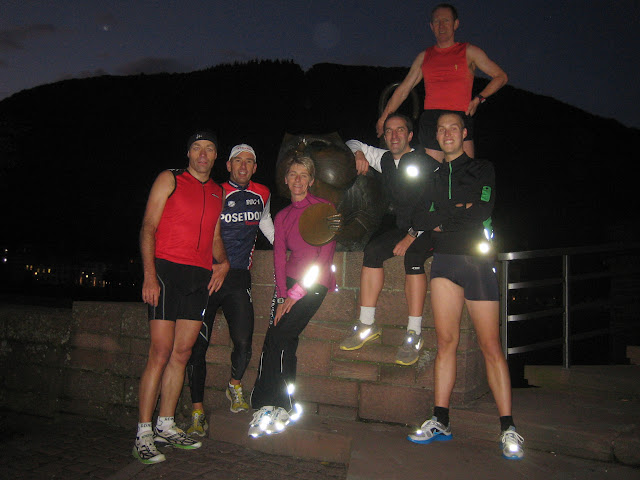
Monday evening at sunset in the medieval town of Heidelberg. Six runners are gathering for another glorious MZUNGO MILE.

When the gun went off, three athletes immediately gapped the rest of the field. Running with ridiculous speed, the racers left flabbergasted tourists, drunk students and veering cars in their dust.

Kicking the hardest, Klaus-Georg managed to dip under the magic five minute barrier while Matthias kept Torsten under control who rounded out the male podium. Caroline took home a convincing win on the women's side.
Organizer Elwiz not only had the chuzpe to race himself but also filmed two sequences of this epic match. It will be downloadable for our premium members at the discounted price of $199.


Stay tuned for the next MZUNGO MILE. It may be just outside your front door.
Wait, it's not? Organize your own MZUNGO MILE!
Two easy steps: find a course and date, and email us to get a logo: askmzungo@gmail.com
MZUNGO MILE - free and funky!

Tuesday, October 26, 2010

Monday, October 25, 2010

TOP 30 - Dublin Marathon 2010

1 Moses Kangogo Kibet Ken MS 1 00:31:11 01:05:22 01:32:24 02:08:58 02:08:58
2 Fikadu Kedir Eth MS 2 00:31:10 01:05:22 01:32:24 02:09:44 02:09:44
3 Mourice Mutinda Musyoki Ken MS 3 00:31:09 01:05:22 01:32:24 02:10:25 02:10:25
4 Chesoo Jonathan Kipchirchir Ken MS 4 00:31:09 01:05:22 01:32:24 02:10:27 02:10:27
5 Aleksey Sokolov Rus MS 5 00:31:09 01:05:22 01:32:24 02:10:31 02:10:31
6 Andriy Toptun Ukr MS 6 00:31:38 01:07:15 01:35:28 02:13:33 02:13:33
7 Tomas Abyu Gbr M100 1 00:31:38 01:06:42 01:35:06 02:14:32 02:14:32
8 Simon Kariuki Njorge Ken MS 7 00:31:10 01:05:22 01:32:24 02:14:46 02:14:47
9 Armon Kemei Kipchirchir Ken MS 8 00:31:10 n/a n/a 02:15:20 02:15:20
10 Mike Fokoroni Zim MS 9 00:31:10 01:05:57 01:34:24 02:15:43 02:15:45
11 Lezan Kimutai Ken M35 1 00:31:10 01:05:58 01:35:27 02:16:23 02:16:26
12 Sergiu Ciobanu Mda M100 2 00:32:13 01:08:44 01:38:13 02:19:31 02:19:33
13 Ruben Indongo Fra MS 10 00:32:00 01:08:44 01:38:16 02:20:36 02:20:38
14 Joe Mcalister Irl M100 3 00:33:27 01:10:33 01:40:12 02:21:02 02:21:05
15 Greg Roberts Irl M100 4 00:33:26 01:10:33 01:40:12 02:21:18 02:21:20
16 Barry Minnock Irl M100 5 00:33:27 01:10:34 01:40:11 02:22:01 02:22:05
17 Alan O'Shea Irl M100 6 00:32:23 01:09:23 01:39:04 02:23:01 02:23:03
18 Vladimir Ponomarev Rus MS 11 00:32:13 01:08:52 01:39:46 02:24:00 02:24:00
19 Stuart Robinson Gbr M100 7 00:33:31 01:11:41 01:42:06 02:24:40 02:24:42
20 Tatiana Aryasova Rus FS 1 00:35:36 01:14:41 n/a 02:26:13 02:26:13
21 Philip Harty Irl MS 12 00:34:56 01:13:10 01:43:53 02:27:08 02:27:10
22 Urga Negewo Eth M100 8 00:31:10 01:07:20 01:39:14 02:27:22 02:27:25
23 Brian Macmahon Irl M100 9 00:33:27 01:10:33 01:40:15 02:27:33 02:27:35
24 Lorcan Cronin Irl MS 13 00:35:24 01:14:13 01:45:11 02:27:36 02:27:38
25 Kateryna Stetsenko Ukr FS 2 00:35:25 01:14:12 01:44:59 02:27:51 02:27:51
26 Elsa Kireeva Rus FS 3 00:35:35 01:14:40 01:45:18 02:27:58 02:28:02
27 Matthew Bidwell Irl M35 2 00:35:25 01:14:12 01:45:10 02:28:20 02:28:23
28 Pauric Mckinney Irl M100 10 00:35:25 01:14:13 01:45:13 02:28:24 02:28:27
29 Diarmuid O' Seaghdha Irl MS 14 00:34:56 01:13:36 01:44:59 02:28:36 02:28:40
30 Tiki Gelana Eth FS 4 00:35:25 01:14:13 01:44:59 02:29:49 02:29:53

mzungo.org exclusive - Dublin Marathon 2010 - Moses Kibet wins in course record time!

mzungo.org exclusive - Dublin Marathon 2010 - Tatiana Arashova wins Dublin City Marathon 2010

mzungo.org exclusive - Dublin Marathon 2010

mzungo.org exclusive - Dublin Marathon 2010 - Moses Kibet @ Mile 24

mzungo.org exclusive - Dublin Marathon 2010

mzungo.org exclusive - Dublin Marathon 2010 - Moses Kibet breaks away!

mzungo.org exclusive: Dublin Marathon 2010


ShareThis